
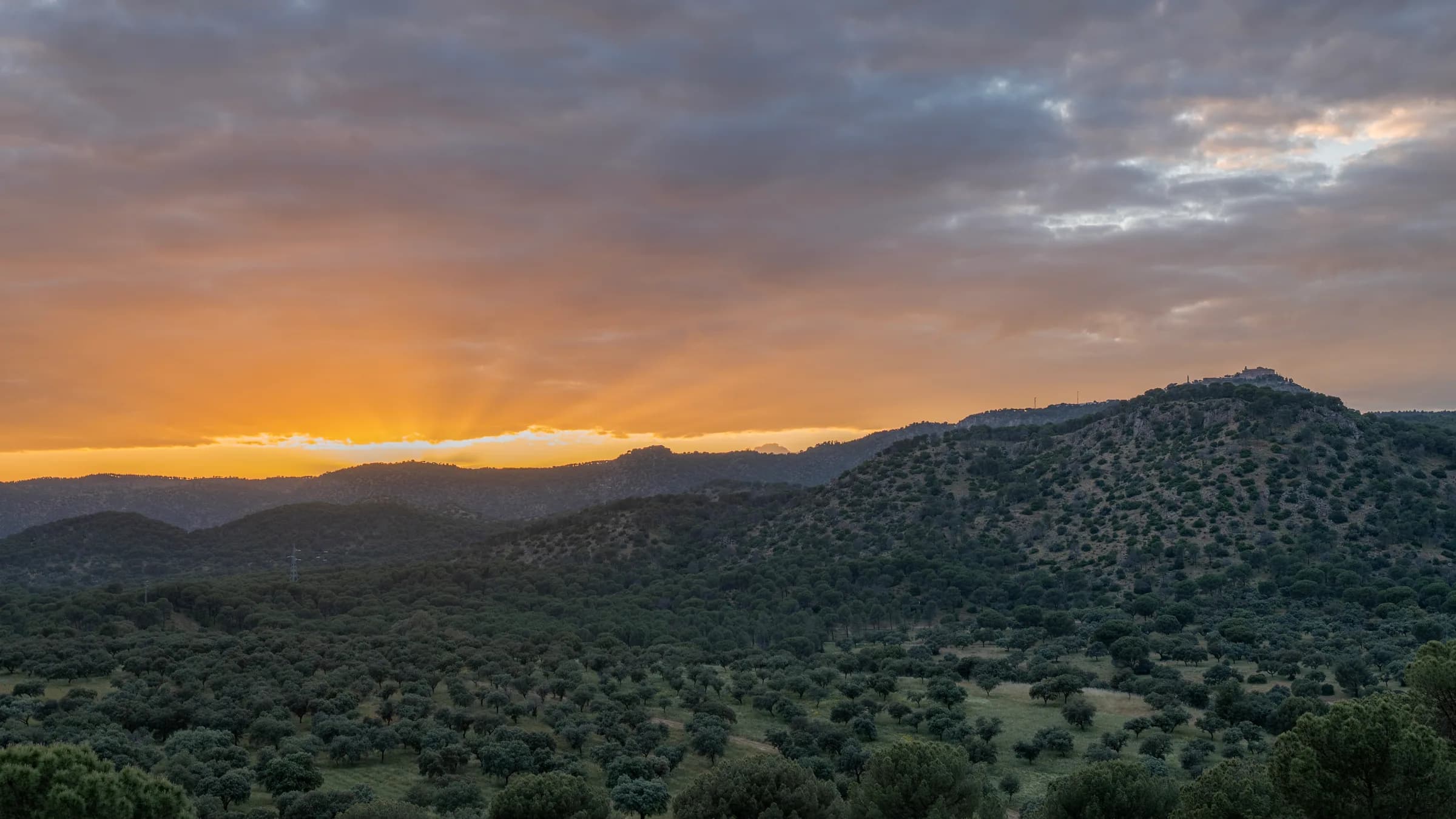
A montería is Spain's signature driven hunt: a large, organized day on which 25 to 50 posted shooters hold fixed pegs — puestos — while packs of Spanish hounds, the rehalas, push wild boar, red deer, and fallow deer through several hundred hectares of Mediterranean mountain scrub. The tradition is oldest and deepest in the Sierra Morena of Andalucía, the season runs from mid-October to mid-February, and a peg on a quality montería typically costs €1,500–€4,000+ per day depending on the estate and the game expected to move. Nothing else in European hunting matches it — not for scale, not for intensity, and certainly not for the lunch afterwards.
I host Huntica's Spanish trips from El Encinarejo in the Sierra de Andújar, and I'll say it plainly: the first time you stand a peg while twenty rehalas open up across the valley — hundreds of hounds working a hillside of holm oak and rockrose, a sounder of boar breaking cover at thirty metres — you understand why Spanish hunters build their entire winter around these days. This guide covers what a montería actually is, how the day runs, what it honestly costs, and how to do it properly as a visiting hunter.
What is a montería?
A montería is a driven big-game hunt on a grand scale, and it is Spain's oldest organized hunting tradition. King Alfonso XI's Libro de la Montería, written in the 14th century, already describes hound packs pushing boar through these same sierras — which means hunters have been doing roughly what you'll do on your peg for seven hundred years. For most of that history it was the preserve of the crown and the landed families of Andalucía. The modern commercial era opened it up: today anyone with a rifle, a licence, and a peg fee can stand where kings once hunted.
The mechanics are simple to describe and extraordinary to watch. The estate selects a mancha — a block of 300 to 800 hectares of cover that has been rested, often for a full year. Shooters are posted around and through it in lines called armadas: along ridgelines, firebreaks, and the stream bottoms below. Then the rehalas go in. A rehala is a pack of 18 to 24 dogs — podencos, Spanish scenthounds, mastiff crosses — handled by a rehalero who will walk thorn and rock on foot for four hours straight. A serious montería fields fifteen to twenty-five rehalas, which puts somewhere between 300 and 500 hounds on the mountain at once. The hardest-working souls on any montería walk behind those dogs.
What makes the montería more than a method is the social architecture around it. It is a one-day festival: breakfast at the farmhouse before first light, the draw for pegs, the drive itself, and then a long, loud lunch where the day is retold peg by peg. Spanish hunting society organizes its winter calendar around these Saturdays. Friendships, business, marriages — a remarkable amount of Andalucían life has been arranged over montería lunches. You are not buying a shooting position; you are being admitted, for a day, into a living tradition.
How does a montería day work?
The rhythm barely varies, and that consistency is part of the pleasure.
The junta (8:00–9:30). Everyone gathers at the finca — shooters, rehaleros, muleteers, the organizer's team. Breakfast is generous and traditional: migas with chorizo, strong coffee, sometimes a glass of anise for those so inclined. It's where you meet the hunters who will hold the pegs beside yours.
The briefing and the draw. The organizer walks through safety: your shooting arcs, the location of neighbouring pegs, the absolute rule that nobody leaves a peg until the drive is formally closed. Then the sorteo — the peg draw. On classic monterías your position is luck; on many commercial days the organizer assigns pegs. Either way, accept your number with grace. The draw is part of the culture, and complaining about a peg before the drive has even started marks you faster than anything else you could do.
Posting (9:30–10:30). A postor drives or walks you to your peg and points out your arcs and your neighbours. You load only once posted, and you stay put. This is the deepest safety code of the montería: 30 to 50 rifles and 400 hounds are on that mountain, and the entire system depends on every shooter being exactly where the map says.
The drive (roughly 11:00–14:30). One long, continuous drive — not the series of short pushes you may know from Germanic driven hunts. For the first while you hear it more than see it: hounds opening up two valleys away, rehaleros' calls echoing, the first shots rolling along a distant armada. Then the cover in front of you starts to move. Boar come through singly and in sounders, at a walk or flat out. Stags slip along contour lines. Some pegs see forty animals; the next sees three. Four hours pass like forty minutes.
The close. Horns and radios end the drive. You unload, and you wait at your peg until collected — even if it takes a while. Game recovery follows, much of it done the old way, with mules bringing boar and stags off slopes no vehicle can reach. Back at the farmhouse the day's game is laid out in rows for the junta de carnes, counted and shown respect, before it enters the regulated game-meat chain.
Lunch (15:00 until it ends). A long table, venison stew or paella, wine for those who want it, and the retelling. Hunters who took nothing get as much airtime as those who took five. It is genuinely the heart of the day — there's a reason Spaniards say a montería is won or lost at the table.
Where are the best monterías? Sierra Morena and Andalucía
The Sierra Morena is the montería heartland, full stop. This long spine of low mountains runs across northern Andalucía through the provinces of Jaén, Córdoba, Sevilla, and Huelva, and its mosaic of holm-oak dehesa, rockrose thickets, and rocky stream valleys is the finest driven big-game habitat in Europe. The names that matter to Spanish hunters — Sierra de Andújar, Cardeña-Montoro, the sierras above Constantina and Cazalla, Aracena — are all Morena country. The neighbouring regions carry the same tradition: the Montes de Toledo, Extremadura, and the Valle de Alcudia in Ciudad Real all run famous monterías.
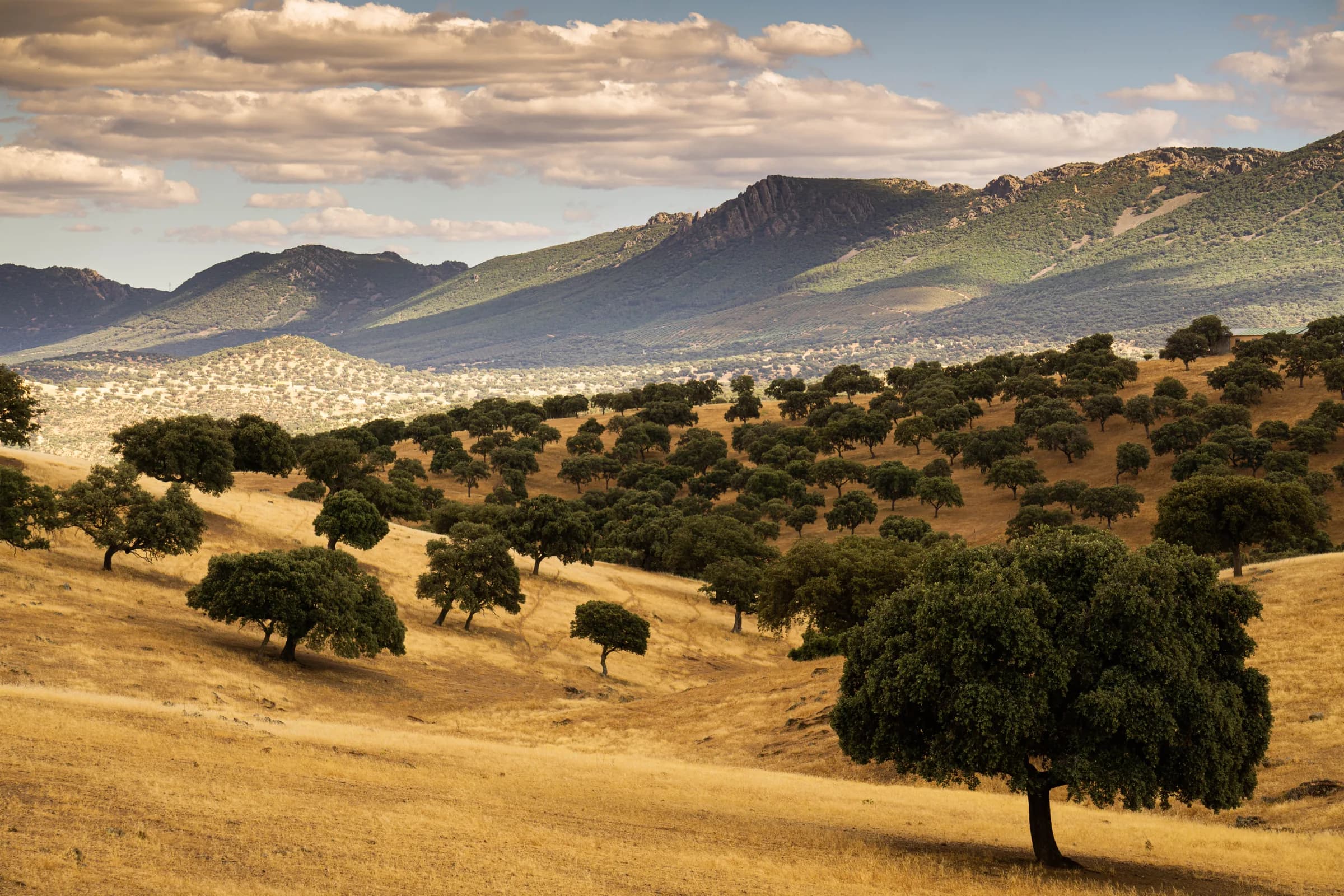
Huntica's Spanish ground sits in the middle of all this. El Encinarejo, in the Sierra de Andújar, is one of the very few places in Spain where the lodge stands inside the hunting area itself — more than 5,000 hectares of managed territory, with the monastery of Virgen de la Cabeza glowing on the opposite hill at dusk. Wild boar is a primary species here alongside Iberian red deer and fallow deer, and that mix is exactly what comes past a peg: the same drives produce boar, stags, and fallow bucks. It is also a working base for the wider region, run by a family outfitting operation whose roots in Andalucían hunting go back generations.
A practical note on choosing ground: the single biggest variable in montería quality is not the province — it's the organizer. The difference between a finca that rested its manchas properly and one that sold the same ground three times in a season is the difference between the best driven day of your life and four quiet hours on a rock. This is precisely where local knowledge earns its keep.
When is montería season in Spain?
The general montería season runs from roughly the second week of October to mid-February, with exact dates set each year by regional game orders. The heart of it is November through January.
- October: The opening weeks. Warm afternoons, cover still thick, boar in good condition after the autumn acorn drop begins. Dog work can be harder in the heat.
- November–December: Prime time. Cool mornings — often near freezing on Sierra Morena pegs at dawn — crisp scenting conditions for the rehalas, game moving well. The most sought-after fincas run their flagship monterías in these weeks.
- January: Many regulars' favourite month. Boar carry their full winter coats and their best tusks are on display; the weather is properly cold; the season's rhythm is at full pace.
- Early February: The closing weekends. A last chance, and often good value as organizers fill final calendars.
Monterías are overwhelmingly Saturday events, with some midweek days on larger estates in high season. The premium fincas fill their calendars by late summer — if you want a specific estate in late November, you book in June, not October.
What game comes past the peg?
The honest answer: whatever the mancha holds, in whatever order it chooses. That unpredictability is the montería's soul.
Wild boar is the headline act. Spain holds one of Europe's strongest boar populations, and the Sierra Morena is thick with them — sounders of sows and young moving fast through the lanes, and occasionally a heavy, solitary old male carrying proper cutters, the animal every peg secretly hopes for. Boar come through at every speed from a trot to a full gallop, and they are tough, dense, low-slung targets that punish casual shooting.
Iberian red deer share nearly every Sierra Morena mancha. Hinds and young stags move in groups; mature stags tend to slip out early and low. What you may shoot depends on the day's cupo — the agreed allocation — and on some estates a medal-class stag carries a supplement. Listen at the briefing.
Fallow deer run on many fincas, including El Encinarejo, where boar, red deer, and fallow can all appear on the same drive. A good fallow buck crossing a firebreak in winter sun is one of the prettiest sights in Spanish hunting. Mouflon appear on certain estates as well.
Across a strong day on quality ground, the full line might account for 40–80 animals between all pegs. Your individual share of that is the draw, the wind, and the dogs — which is exactly as it should be.
How different is the shooting on a driven hunt?
Very, and it's worth being honest about the gap. If your experience is stand hunting and stalking — calm animals, a rest, time to settle — a montería will humble you on day one. The standard shot is a boar crossing a cut lane at 20 to 80 metres, visible for three or four seconds, often moving fast. There is no rest, no second look, and no time to dial anything.
Calibers. You want a cartridge that anchors heavy game decisively at modest range. The classic driven choices are the 8x57 IS, the 9.3x62, and the .300 Winchester Magnum, with the .30-06 close behind — all proven, all sensible. Spanish hunters have run the 9.3x62 on boar for a century for good reason. Pick stout, controlled-expansion bullets on the heavy side for your caliber; boar shoulders and shields are armour, and a frangible deer bullet is the wrong tool. A well-regulated double rifle in 9.3x74R is a beautiful, traditional option if you own one.
Optics. This is where most visitors are under-equipped. A 3-15x scope dialled to 8x is a liability on a peg. The right setups are a red-dot sight or a low-power variable — 1-6x24 or 1-8x — left on 1-2x with an illuminated reticle. Field of view beats magnification every single time on driven game.
Technique. Shoot a montería the way you shoot driven birds: weight forward, mount the rifle like a shotgun, swing through the animal, keep both eyes open. If you can, put in sessions at a running-boar cinema range before you travel — Madrid has good ones, and most German and Scandinavian hunters can find one at home. Two hours on the screen is worth more than two hundred rounds at a static target.
Ethics at the peg. The discipline that makes you a good stalker makes you a good montería gun: pass everything you cannot place well. Take animals in your cleared lanes, let game cross to a neighbour rather than stretch a marginal angle, and never shoot toward the line. If you wound a boar, mark the line of travel and tell the recovery teams — the dogs will do the rest. The hunters who earn invitations back are rarely the ones who shot the most; they're the ones who shot the best.
What does a montería cost?
Montería pricing is refreshingly transparent once you understand the structure: you buy a peg for the day, and the fee scales with the quality of the estate and the game expected to move. Indicative figures for the current market:
- Entry-level commercial monterías: €900–€1,500 per peg. Honest days on modest ground; quality varies with the organizer.
- Good Sierra Morena fincas: €1,500–€2,500 per peg. Properly rested manchas, proven game density, well-run organization. This is the sweet spot for most visiting hunters.
- Premium estates: €2,500–€4,000 per peg. The names with decades of reputation, strong boar numbers, and genuine medal-stag potential on the same drives.
- Historic, invitation-grade fincas: €4,000+. The handful of legendary properties where the calendar fills by word of mouth among friends.
What the peg fee includes. Organization (those rehalas each cost the organizer several hundred euros a day), peg placement and the postor, breakfast and the long lunch, and game recovery. On most days boar are "open" — you may take what crosses your peg — while deer run to the day's cupo, something like two stags plus hinds, announced at the briefing.
What can cost extra. Medal-class stag supplements on estates that run them (typically €1,000–€4,000 depending on class), trophy preparation per animal, rifle rental at €50–€100 per day, your regional licence and mandatory insurance (€100–€200, arranged through the organizer), hotels on self-booked trips, and tips.
A realistic trip total. Most international hunters build a long weekend around one or two Saturday monterías, often with stalking days between. Self-booked, with flights inside Europe, two mid-tier pegs, hotels, licence, and rental rifle, expect €4,500–€9,000 all told — more if a gold-medal stag steps out and you take him.
With Huntica hosting, the structure is simpler: one all-in figure agreed before you commit, covering the peg, the lodge, transfers, paperwork, and a host at your side — with supplements and options put in writing up front, so nothing at the lunch table comes as a surprise. A Huntica Hosted Spanish week is built around exactly this combination: montería day plus stalking days from the lodge.
What is the etiquette for international hunters?
Monterías run on social code as much as on rules, and visiting hunters who learn the code are welcomed with real warmth. Peer to peer, here is what matters:
- Be on time. The junta starts early and nobody wants to be the organizer holding thirty hunters for one car. Arrive with daylight to spare.
- Dress the part, quietly. Spaniards turn out in loden green and traditional teba jackets; you don't need the wardrobe, but muted greens and browns, good boots, and proper layers do. Sierra Morena mornings can sit near zero and the afternoon can touch 20°C. Most regions now require a high-visibility garment at the peg — pack a blaze vest or cap regardless of where you hunt.
- The peg is sacred. You do not leave it, for any reason, until the drive is closed and you are collected. This is the rule Spanish hunters use to judge whether you can be invited anywhere again.
- Respect the cupo. Don't shoot young stags, and when in doubt, pass. Nobody at lunch remembers the man who filled his allocation; everyone remembers the man who shot something he shouldn't have.
- Honour the table. Lunch is not an optional extra to be skipped for an early flight — it is the point. Stay, eat, tell your peg's story, and ask about everyone else's. If you don't drink, no one blinks — our GCC guests have always found the table just as generous without the wine.
- Tip the hands. A note for the postor who placed you and the muleteers who brought your boar off the mountain — €20–€50 each — is not obligatory, but it is noticed and appreciated. The rehaleros walked further than anyone; a word of genuine thanks to them lands well too.
- Learn ten words of Spanish. Buen puesto — good peg — goes a remarkably long way.
How do firearms logistics work for visiting hunters?
For EU hunters, Spain is straightforward: the European Firearms Pass plus an invitation letter from the organizer covers temporary import, and many Danish and German hunters drive or fly with their own rifles every season. If you're coming from Scandinavia, our guide for Nordic hunters walks through the EU Firearms Pass application and Copenhagen logistics in detail.
For non-EU visitors — UAE, US, UK, and beyond — it takes more lead time but it is well-trodden ground: an invitation from the Spanish organizer, advance authorization, and a temporary import processed with the Guardia Civil's arms office at your arrival airport. Start the paperwork six to eight weeks out and fly through Madrid where possible. Our international firearm import guide covers the full process country by country.
The honest alternative for a first montería: rent. Spanish outfitters keep well-maintained driven rifles in sensible calibers with appropriate optics, at €50–€100 per day. For a single weekend, renting removes the one piece of friction in an otherwise simple trip — and on a hosted trip we stage everything so a rifle is zeroed and waiting when you arrive.
What does a hosted montería with Huntica look like?
A montería has one genuinely weak point for a visiting hunter: you are buying a day from an organizer you've never met, on ground you've never seen, in a tradition full of unwritten rules. Hosted is how we close that gap.
I host our Spanish trips personally, and the work happens long before the junta. We hold relationships with organizers we trust as favored partners — the ones who rest their manchas, field proper rehalas, and run honest days — and we pass on the oversold ones, which is the quality control no listing site can do for you. Where pegs are assigned rather than drawn, those relationships matter; where the draw is random, we manage everything around it so the only variable left on your day is the mountain itself.
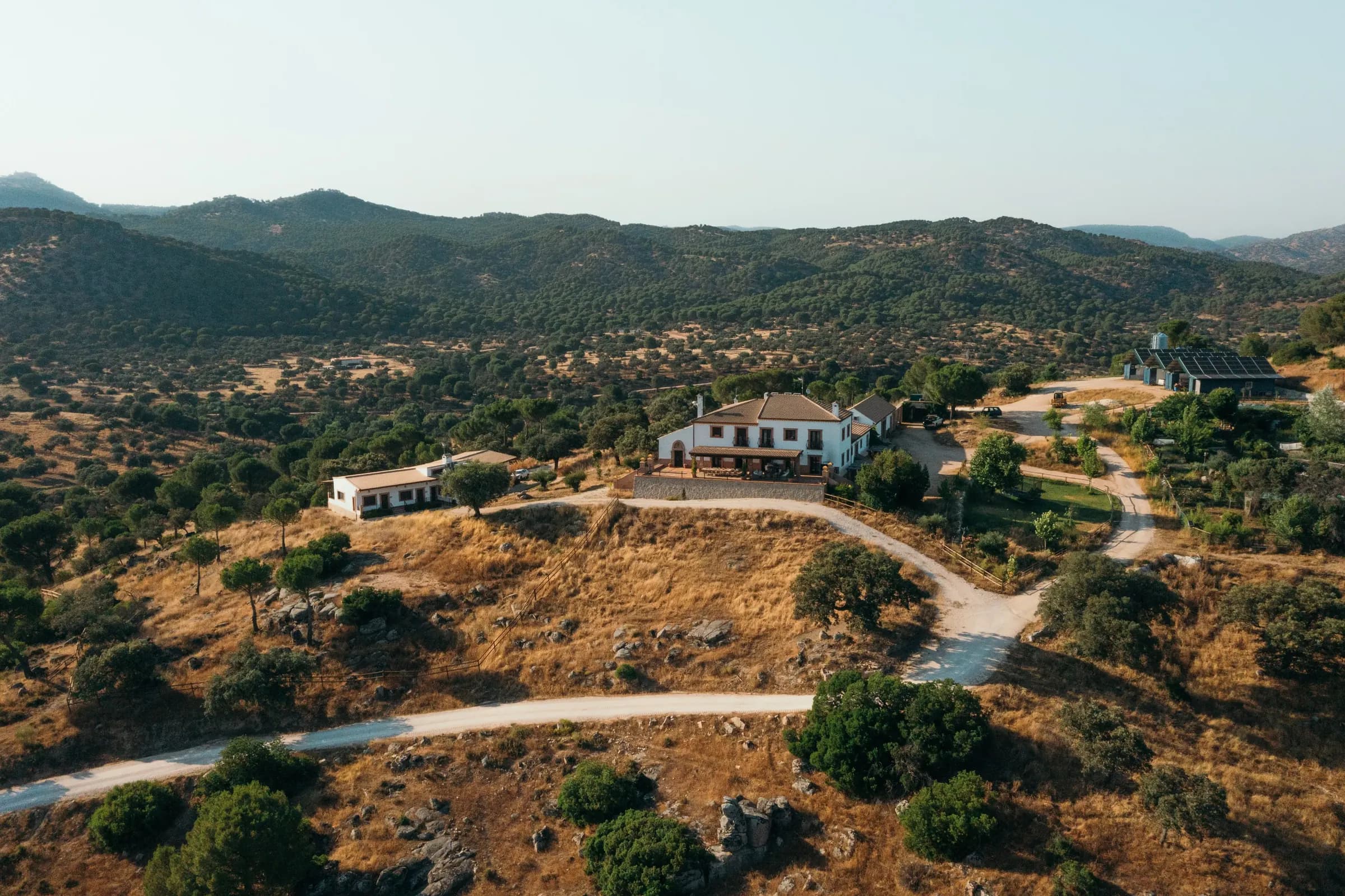
The base is El Encinarejo, our Approved Ground in the Sierra de Andújar — a premium lodge standing inside its own 5,000+ hectares, with en-suite rooms, a bar, a fireplace, and the monastery lights across the valley at dusk. A typical hosted week pairs a Saturday montería with stalking days for red deer, fallow, and boar straight from the lodge, designed by the hour around your group. This is the same Andalucían estate culture that built Spain's famous driven partridge tradition, and it shows in everything from the breakfasts to the way the staff treat a returning group like family.
And if you're thinking about a montería for your firm or your circle of friends, you've spotted what Spanish business figured out generations ago: one shared day — briefing, drive, long table — is the best group format in hunting. That is exactly what Huntica Brotherhood trips are built for: corporate and friendship groups, hosted end to end, with non-shooting guests welcome at the lodge.
Frequently Asked Questions
Is a montería suitable for a first-time driven hunter?
Yes, with honest preparation. The safety system is mature — briefing, fixed arcs, the no-leaving-the-peg rule — and organizers are used to first-timers. Do three things before you travel: practise on a running-boar cinema range, set up a low-power or red-dot optic, and tell your host it's your first driven day so you're posted somewhere with clear lanes and a calm neighbour. Then hold your standards and pass anything marginal — a quiet, disciplined first montería is a success.
How many boar can I expect to shoot on a montería?
Anywhere from none to six or more — that range is the truth, and anyone promising otherwise is selling something. On good Sierra Morena ground a fair expectation is two to four genuine opportunities at your peg over the drive, with the full line accounting for 40–80 animals on a strong day. The draw, the wind, and the dogs decide the rest. The tradition has lasted seven centuries because the day is bigger than the bag.
Are Spanish monterías free range or fenced?
Both exist. Much of the Sierra Morena is open ground where boar move freely between fincas, while some estates run fenced territory, mainly for deer management — and the best of those are so large the fence is irrelevant to how the game behaves. The real question is whether the ground is honestly managed and the manchas properly rested, which you cannot tell from a website. It's one of the specific things we vet before any ground earns Huntica Approved status, and we'll tell you plainly what any given day is.
Can I combine a montería with stalking on the same trip?
Yes — and it's the format we recommend. Monterías run mostly on Saturdays, which leaves the week open for rececho, Spanish stalking, at exactly the right season. From El Encinarejo you can stalk Iberian red deer, fallow, and boar on the lodge's own ground between driven days, and extend into the mountains for ibex on a longer trip. The two styles sharpen each other: the stalking shows you the country at walking pace, and the montería shows you what lives in it.
What happens to the meat after a montería?
It is handled properly and almost none of it is wasted. After the junta de carnes, game passes into Spain's regulated wild-meat chain — every boar is tested for trichinella before entering it — and Spanish wild boar and venison end up in butcheries and restaurants across Europe. As a visiting hunter you won't ship meat home, but you'll likely eat the estate's own game at lunch, and your trophies — tusks, skulls, full mounts — can be prepared and shipped through the normal taxidermy route.
Do I need a Spanish hunting licence, and how do I get one?
Yes. You need a hunting licence for the autonomous region you hunt in — Andalucía for the Sierra Morena — plus mandatory hunter liability insurance. Both are routine for visitors: the organizer or your host arranges them from a copy of your passport and your home hunting licence, usually inside a couple of weeks, for roughly €100–€200 combined. On a hosted trip the paperwork is done before you land; it's the kind of friction you should never have to think about at the junta.
Tell us where you want to go
If the montería has been living in your head — the hounds opening up across a valley, a heavy boar breaking cover, the long table afterwards — the next step is a conversation. Tell us where you want to go, and I'll walk you through what a hosted Spanish week looks like from El Encinarejo: which monterías are worth your peg fee this season, how the stalking days fit around them, and what it all costs as one straight number. No brochures. Just a conversation between hunters about the oldest driven tradition in Europe.