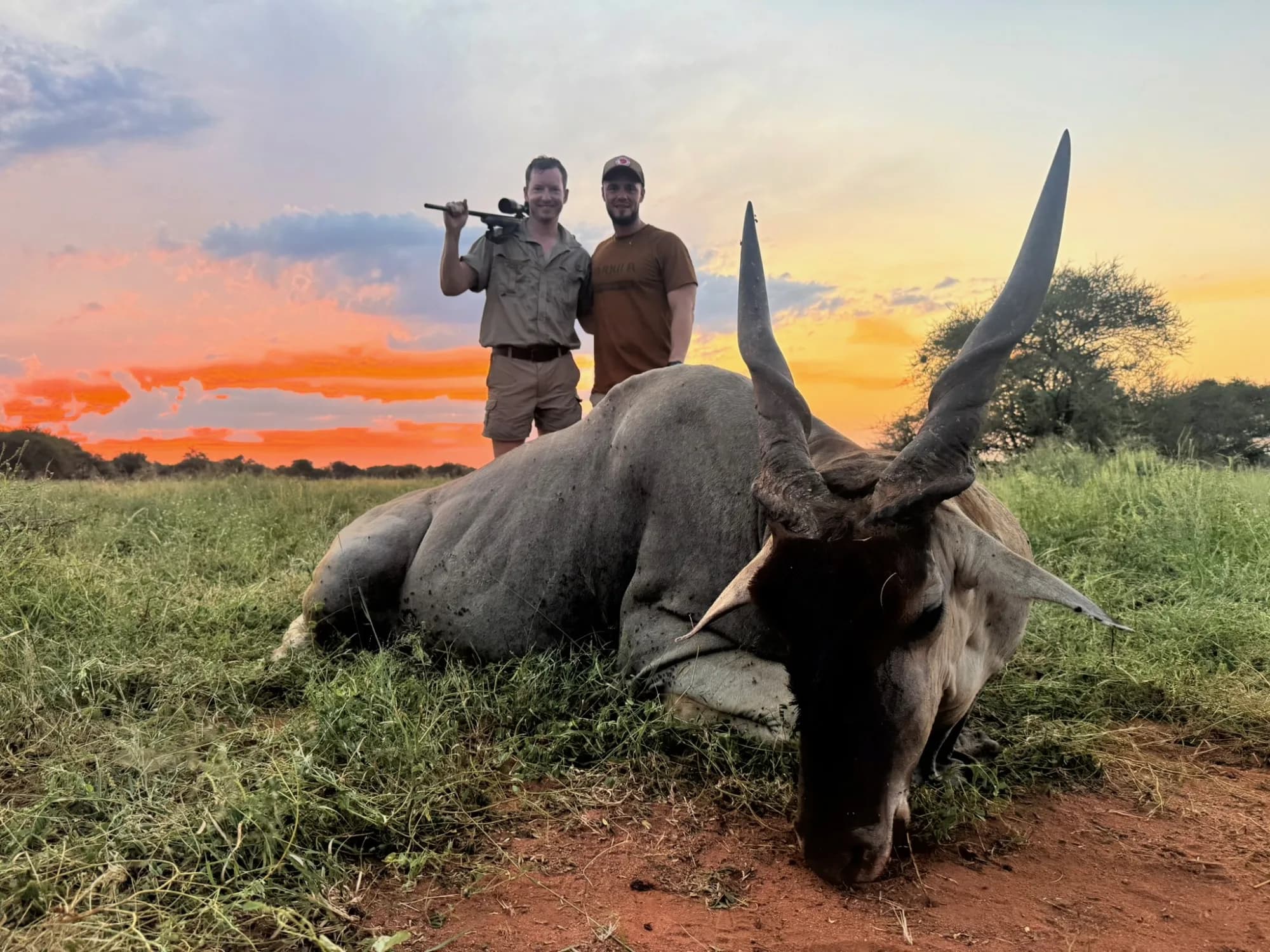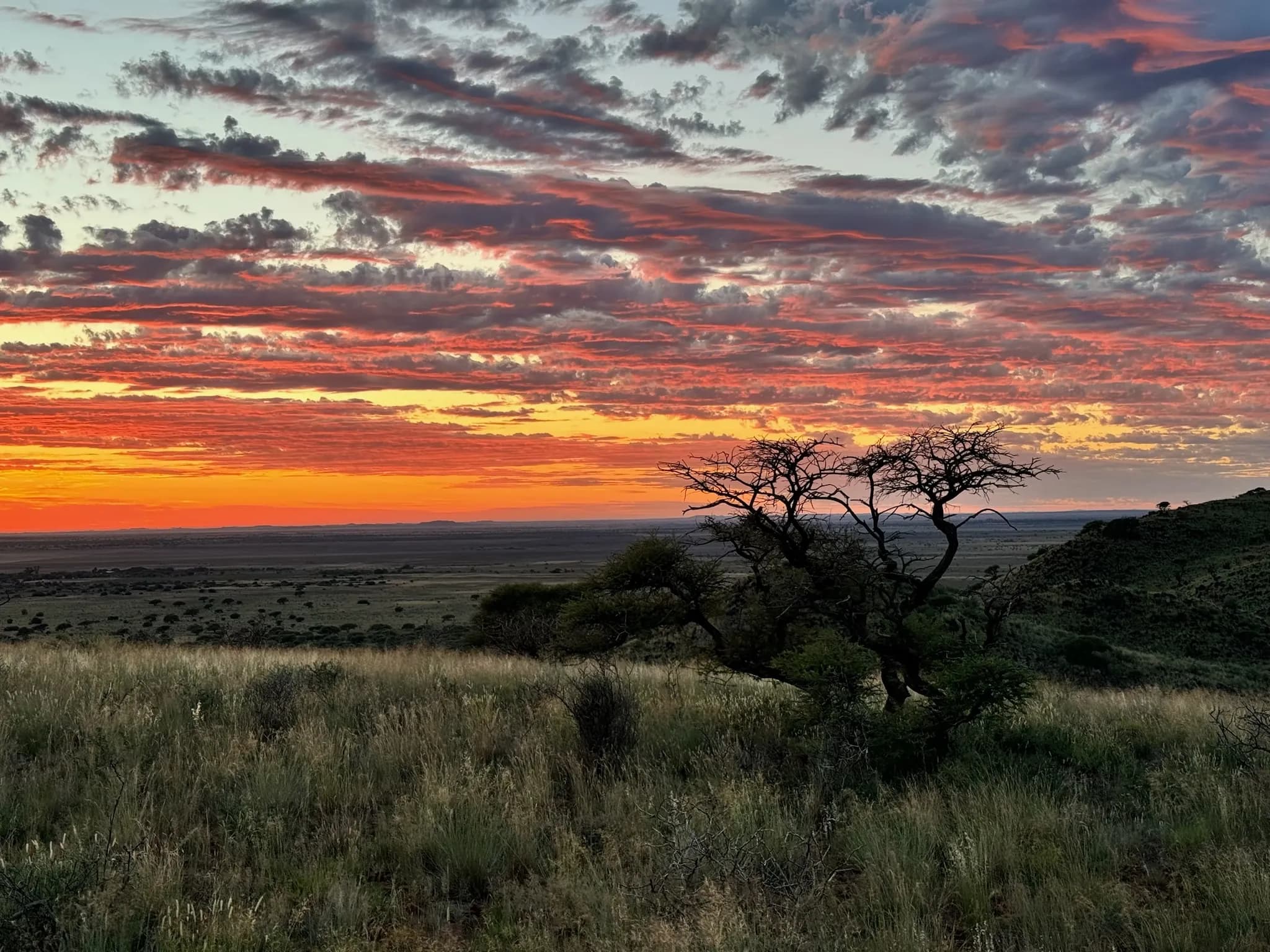
Gemsbok hunting in South Africa is the spot-and-stalk pursuit of the gemsbok (Oryx gazella) — the largest of the oryx species and the signature trophy of the Kalahari — across open, arid country where long shots and patient stalking are the rule. Mature animals stand 1.2 metres at the shoulder, weigh 180-240 kg, and both sexes carry straight, rapier-like horns, with 40 inches the benchmark for an exceptional trophy. The Northern Cape, which holds South Africa's share of the Kalahari, produces the country's finest gemsbok. On private ranch ground they can be hunted year-round, with May through September the prime window. Market-typical costs run $350-$500 per day plus a gemsbok trophy fee of $1,200-$1,800.
I have hunted gemsbok since I was a boy — seven generations of my family on South African soil — and no plains game animal earns more respect from Professional Hunters. The gemsbok lives where almost nothing else thrives, sees you coming from a kilometre out, and carries a reputation, earned rather than invented, for absorbing marginal hits and covering miles afterward. PHs trade stories about lions that came off second-best against those horns. Hunt one properly, on foot, and you will understand why gemsbok turn first-time African hunters into repeat ones.
What makes gemsbok hunting special?
Start with the animal itself. A gemsbok is unmistakable: a steel-grey body, a black-and-white painted face that looks almost ceremonial, black flank stripes, a long horse-like tail, and those horns — straight, ringed at the base, tapering to needle points, often longer than a metre. Namibia put the gemsbok on its coat of arms for a reason. A herd strung out along a red dune at first light is one of the great sights in African hunting.
Then consider what it survives. Gemsbok are true desert antelope. They can live entirely without surface water, drawing moisture from tsamma melons, wild cucumbers, and roots they dig from the sand. On the hottest days they allow their body temperature to climb to around 45°C — heat that would put down most mammals — while a fine network of blood vessels in the nasal passages, the carotid rete, cools the blood reaching the brain. The gemsbok is engineered for country that punishes everything else.
That country defines the hunt. Where kudu hide in thick bush and test your ears and your patience, gemsbok stand in the open and test everything else. Their eyesight is exceptional, the terrain offers little cover, and a herd of thirty animals at 400 metres is a security system with no blind spots. Closing to an honest shooting distance across open ground — using dead ground, scattered camelthorn, rock outcrops, and the wind — is proper hunting craft. No shortcuts.
And finally, the toughness. Ask any PH in the Northern Cape to name the toughest plains game animal per kilogram and most will answer gemsbok without looking up. Dense shoulder muscle, heavy bone, and vitals set lower and further forward than most hunters expect mean a poorly placed bullet is rarely forgiven — gemsbok absorb marginal hits and keep moving. There are credible records of gemsbok fatally goring lions. None of this makes them impossible. It makes them worth doing properly, with the right rifle, the right bullet, and the discipline to wait for the right angle.
Where to hunt gemsbok in South Africa
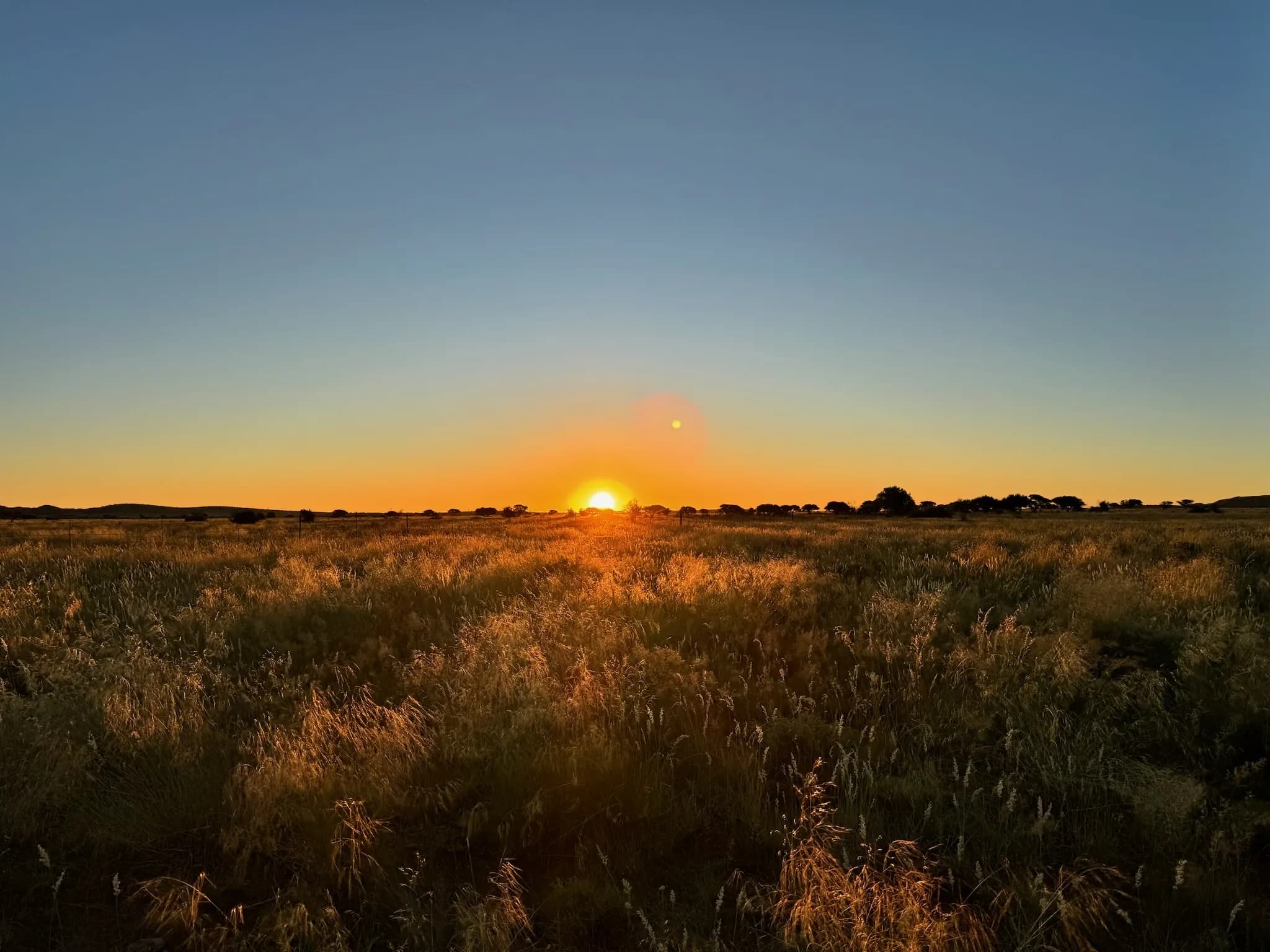
The Northern Cape is the heartland. South Africa's largest and driest province holds the country's share of the Kalahari — red sand, dune veld, camelthorn trees — plus vast open bushveld and Karoo fringe further south. This is the country gemsbok evolved for, where densities are highest and the long-range, spot-and-stalk character of the hunt is at its purest. If you want the postcard gemsbok hunt, you want the Northern Cape.
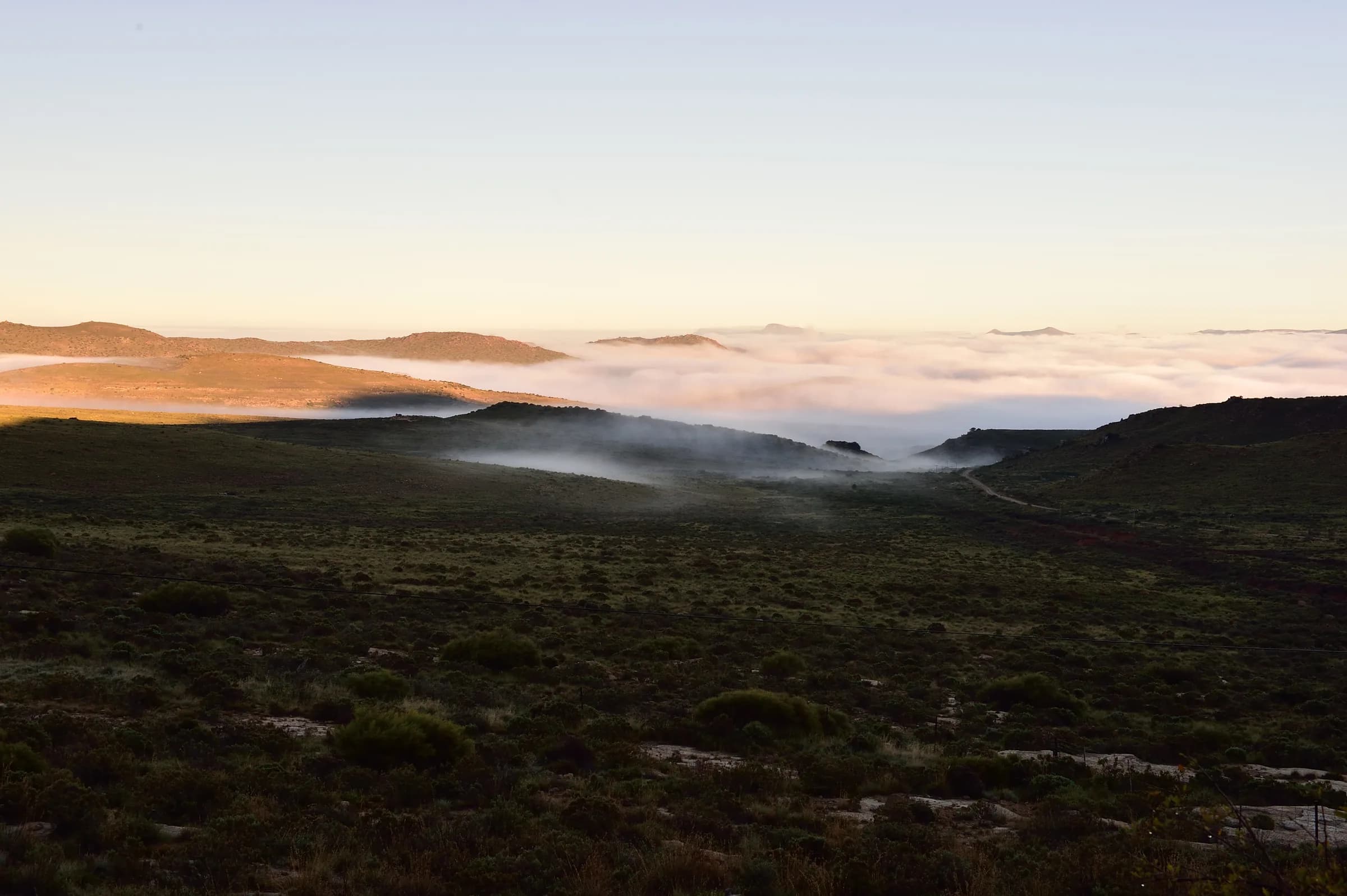
On Huntica Approved Ground, our Magersfontein concession sits between Kimberley and Jacobsdal on roughly 7,000 hectares of open bushveld and rocky outcrops, with additional concessions in the surrounding area. Gemsbok are a staple species here, alongside springbok, sable, roan, buffalo, and colour variants including golden gemsbok. Game density is genuinely high — hunters consistently describe the ground as target-rich — and the lodge sits on the hunting area itself, less than 30 minutes from Kimberley airport. You step off the veranda and onto the hunt.
Beyond the Northern Cape, gemsbok do well anywhere dry and open: the Free State plains, the Karoo regions of the Eastern and Western Cape, and parts of Limpopo all carry huntable populations. Across the border, Namibia — where the gemsbok is the national animal — offers superb desert hunting on enormous tracts. For American readers: the only sizeable free-range oryx population outside Africa roams New Mexico, descended from animals released in the 1970s.
For a dedicated gemsbok hunt with Huntica, Magersfontein is where I host. The combination of density, trophy quality, and hunting out the back door of the lodge is hard to argue with.
When is gemsbok hunting season?
The practical answer: whenever suits you. Nearly all plains game hunting in South Africa happens on privately owned, exempted game ranches, where gemsbok may be hunted year-round. Formal provincial seasons exist, but on ground like Magersfontein the calendar is set by climate and comfort rather than regulation. Gemsbok carry permanent horns — no velvet cycle, no seasonal shed — so trophy quality is constant across the year.
What changes is the experience:
May-September (prime season — Southern Hemisphere winter): This is when I bring most gemsbok hunters. The veld is dry and thin, visibility is at its best, and game moves predictably between feed and water. Days are mild — 18-24°C, ideal for walking — and the dry winter air delivers that hard, clear Northern Cape shooting light. Nights are properly cold: Kalahari temperatures can drop below freezing before dawn, so pack warm layers for the early starts.
March-April (green season): After the summer rains the veld is green, the animals are well-fed, and the country is at its most beautiful. Stalking cover improves and temperatures are pleasant. The trade-off is taller grass and more dispersed herds, which can slow trophy selection.
October-February (summer): Honest advice — this is the hard season. Midday temperatures in gemsbok country regularly reach 35-40°C, so hunting compresses into the first three hours of light and the last two, with a long siesta between. It can absolutely be done, and the early light is spectacular, but if your calendar is flexible, choose winter.
For a first gemsbok hunt, book June through August. Conditions stack everything in favour of long glassing sessions and careful stalks.
What caliber for gemsbok?
Treat a gemsbok as you would an animal half again its size. Dense muscle, heavy shoulder bone, low-set forward vitals, and the open-country distances of the Northern Cape — typically 150-300 metres — put real demands on both rifle and bullet.
Minimum: .270 Winchester with 150-grain premium controlled-expansion bullets. This is the floor, not the recommendation. It works on broadside presentations with disciplined placement, but it leaves no margin on quartering angles, and quartering angles are what gemsbok give you.
Recommended: .300 Winchester Magnum or .30-06 Springfield with 180-grain premium bullets. The .300 magnums are the gemsbok caliber in the Northern Cape — flat enough for honest 250-300 metre work, heavy enough to break through the shoulder on a quartering animal. A .300 Win Mag with 180-grain Barnes TTSX, Swift A-Frame, or Nosler Partition is as close to ideal as it gets. The .30-06 does the same work inside 200 metres.
Also excellent: 7mm Remington Magnum (160-175 grain), .308 Winchester (180-grain bonded, inside 200 metres), .338 Winchester Magnum.
If buffalo is on your list: bring the .375 H&H and use it for everything. With 300-grain A-Frames or TSX it anchors gemsbok with authority and saves you travelling with two rifles.
Bullet construction matters more than the headstamp. Gemsbok are precisely the animal that punishes thin-jacketed cup-and-core bullets built for deer — they flatten on that shoulder, penetration stops short, and the tracking job begins. Bonded or monolithic only: Barnes TTSX, Swift A-Frame, Nosler Partition, Federal Trophy Bonded.
Zero at 200 metres, know your drop at 300, and practice off shooting sticks — standing and sitting — before you fly. In open country, the sticks are your bench.
Shot placement on gemsbok
If you remember one thing from this guide, make it this: gemsbok vitals sit lower and further forward than you think. The heart lies low in the chest, tucked between the shoulders. The plains game habit of aiming "just behind the shoulder, middle of the body" — learned on deer — drifts into the liver or paunch on a gemsbok, and a gut-hit gemsbok can cover kilometres before it beds down.
Broadside: Follow the front leg up and place the bullet on the lower third of the body, square on the shoulder line. You are deliberately shooting through shoulder muscle and bone to reach the heart and lungs — which is exactly why premium bullets are non-negotiable. Hit there, a gemsbok rarely goes 100 metres.
Quartering away: The best angle you will get. Aim for the opposite shoulder and let the bullet travel forward through the chest. Penetration requirements are serious — 40-plus centimetres on a big animal — so this is .300-with-premium-bullet territory.
Quartering toward: Wait if you can. The near shoulder shields the vitals and the margin is thin. Inside 150 metres, with a .300 magnum and a monolithic bullet, it is workable for an experienced shot. Otherwise let the animal turn.
Frontal: Gemsbok in open country will often stand facing you, head high, daring the question. Most PHs will tell you to wait, and they are right — the chest target is narrow and a few centimetres of error wounds rather than anchors. Experienced hands only, inside 100 metres, off a dead-steady rest. Everyone else: breathe, hold, wait for the turn.
After the shot: If the animal is standing, shoot again. Gemsbok rarely show a hit the way softer animals do — no hunch, no stagger, just a flat-out run that looks identical to a clean miss. Pay the insurance. And when you walk up, approach from behind with your PH leading. A downed gemsbok that lifts its head can swing 90 centimetres of horn faster than you can step back. More PHs carry scars from "finished" gemsbok than from most animals with teeth.
How to judge a gemsbok trophy
Gemsbok judgment carries a twist most first-time hunters do not expect: both sexes carry horns, and the cows often carry longer ones. Telling them apart — and deciding which you actually want — is half the game.
Bulls: thicker horns with heavier bases, typically 6.5-7.5 inches in circumference, carrying mass well up the horn. Length usually runs 33-38 inches, with tips often blunted or polished from fighting and digging. Bull horns tend to be straighter and more symmetrical, and the animal under them is visibly heavier — thicker neck, deeper chest, more muscle over the shoulder.
Cows: thinner bases of 5-6 inches, but frequently longer horns — 36 to 44 inches and beyond — with sharp, intact tips. Cow horns often show a gentle backward sweep or a slight outward splay. Nearly every gemsbok over the magic 40-inch mark is a cow.
The benchmarks:
- 36-38 inches: a fully mature, representative gemsbok and a genuine trophy — this is what most hunters take on good ground.
- 40 inches: the Rowland Ward minimum (measured on the longer horn) and the number every gemsbok hunter carries in his head. A 40-inch gemsbok is exceptional anywhere in Africa.
- 42-44+ inches: once-in-a-career territory, almost always a cow.
- SCI scoring adds both horn lengths plus both base circumferences, with a minimum entry of 88 inches. The two systems reward different animals: a heavy-based 36-inch bull can outscore a 41-inch cow on SCI, while Rowland Ward crowns the cow. Decide before the hunt whether length or mass matters more to you, and tell your PH.
How to field-judge horn length: The PH standard is the face. From horn base to nose tip, a mature gemsbok measures roughly 19-20 inches. Horns that look double the face length are pushing 38-40 inches. Horns that make you blink — too long for the animal carrying them — usually belong to a 40-plus cow. For bulls, look past length at the bases: mass that carries to mid-horn is what separates a good bull from a great one.
The real difficulty is not the arithmetic — it is doing the arithmetic on one animal inside a milling herd of thirty, through heat shimmer, at 300 metres. This is where your PH earns his keep. Mine have judged thousands. When he says "the third cow from the left, she is the one," believe him.
What does a gemsbok hunt cost?
Gemsbok are among the most accessible of Africa's marquee trophies. Here is a realistic, transparent breakdown.
Daily rates: $350-$500 per day in the Northern Cape, covering accommodation, meals, PH services, trackers, and field vehicles. Five days is a sensible minimum for a dedicated gemsbok hunt; seven days is the norm for a mixed-bag safari built around gemsbok. Daily rate subtotal for 7 days: $2,450-$3,500.
Gemsbok trophy fee: $1,200-$1,800 for a common gemsbok on most South African ground. Some operations tier pricing by horn length, with 40-inch-plus animals commanding the upper end or a modest premium.
Colour variants: The golden gemsbok — a recessive colour variant with a pale gold body and the same painted face — runs far higher: commonly $4,500-$9,000 depending on quality, with exceptional animals above that. Magersfontein carries golden gemsbok among its colour variants if that interests you.
Companion species: Gemsbok country is natural mixed-bag country. Typical additions and indicative fees: springbok ($350-$500), blue wildebeest ($800-$1,200), red hartebeest ($900-$1,400), Burchell's zebra ($1,200-$1,800), kudu ($1,500-$3,500), eland ($1,800-$3,000). Most hunters add three to five species, putting additional trophy fees at $2,000-$5,000.
Total trip cost (self-booked): For a 7-day Northern Cape safari including gemsbok and 3-4 companion species — flights from Europe or the US, daily rates, and trophy fees — expect $6,000-$11,000 per hunter before taxidermy and shipping.
With Huntica hosting: A Huntica Hosted group trip to Magersfontein is quoted as one all-in figure per hunter, depending on group size and species list; a Huntica Bespoke private trip for two to four hunters sits at the higher end. That covers daily rates, hosting, trophy fees for the agreed species list, all transfers, accommodation, meals, and drinks at the lodge.
What is not included: international flights (€800-€2,500 from Europe, $1,200-$3,000 from the US), taxidermy and shipping (see next section), the SAPS temporary firearm import permit (approximately ZAR 200 in administration), travel insurance, and gratuities — industry standard is 8-10% of daily rates and trophy fees for your PH, plus €15-€25 per day for trackers and camp staff.
Taxidermy and getting your gemsbok home
A gemsbok rewards you twice — once in the field and again on the wall, because every part of the animal displays beautifully.
Mount options:
- Shoulder mount: The painted face and metre of straight horn make gemsbok shoulder and pedestal mounts among the most dramatic in African taxidermy. South African taxidermy cost: $700-$1,600 depending on the house and the finish.
- European (skull) mount: A cleaned skull with those long black horns is arguably the most striking skull mount in Africa, at a fraction of the cost — $150-$400. An easy choice when you are taking several animals.
- Flat skin: The grey hide with its black-and-white markings makes a superb rug or wall hide. Dip-and-pack preparation for export runs $100-$200.
On the ground: Magersfontein has a skinning shed, cooler, and salting facilities on the farm, staffed at any hour — your trophy is caped and in salt quickly, exactly what you want in warm country.
Dip-and-pack and shipping: Every trophy leaving South Africa is treated and packed by a registered facility ($80-$150 per trophy), then shipped — usually by sea in a consolidated wooden crate. Figure $1,500-$3,500 to Europe and $2,000-$4,500 to the US for a multi-trophy crate, with transit of 4-6 months to Europe and 6-8 months to the States. Air freight cuts that to weeks at roughly three times the cost.
Paperwork: Gemsbok are not CITES-listed, so no CITES permit is required for import into the EU or US — just the standard South African veterinary export certificate and, for American hunters, a USFWS Form 3-177 declaration. Straightforward.
For the full picture — mount decisions, crate consolidation, brokers, and timelines — read our trophy shipping and taxidermy guide. On a Huntica trip, your host coordinates the whole chain with our favored partner taxidermists and follows the crate until it reaches your door.
What a hosted gemsbok hunt looks like with Huntica
A gemsbok hunt at Magersfontein is glassing-led, spot-and-stalk hunting in open country — and it starts the moment you step off the veranda, because the lodge sits on the hunting ground itself. No long daily drives to reach the hunting area.
A typical day begins at 05:30 with coffee in the dark, then out to a vantage point for first light. Gemsbok feed in the open through the early hours, and in that flat winter light you will pick up herds at a kilometre or more — pale grey shapes against red ground, horns catching the sun like blades. Then the work starts: studying the herd through binoculars, finding the right animal, and planning a route through dead ground, scattered camelthorn, and rock outcrops with the wind in your face. The distance closes from 600 metres to 350, to 250. The sticks go up. And then it is on you — one steady shot at an animal that has no idea you exist.
Expect to walk 6-12 kilometres a day over easy-to-moderate terrain. The ground is target-rich, so most hunters take their gemsbok between day two and day four — which leaves the rest of the week for springbok and wildebeest, or for going again after an old cow pushing 40 inches.
Typical 7-day itinerary:
- Day 1: Fly into Kimberley (KIM) via Johannesburg or Cape Town. Thirty-minute transfer to the lodge. Rifle check on the range, sunset drive, first dinner around the fire.
- Days 2-6: Morning and afternoon hunting blocks — out at first light, midday break at the lodge, back out from 15:00 until dark. Gemsbok takes priority; companion species are taken as opportunities arise during the stalks.
- Day 7: Final morning hunt or photo drive, pack, and depart.
Bowhunters are well catered for — elevated blinds over water make winter archery for gemsbok genuinely productive — and the lodge suits non-hunting companions, with Kimberley's Big Hole and diamond museum half an hour away and a hospital nearby for added reassurance.
The Huntica difference is the layer above the PH. Your host — me, on this ground — is in camp and in the field with your group all week: handling the SAPS firearm desk before you land, reshuffling the plan when the wind turns, talking a hunter back to steadiness after a miss, and making sure the non-hunters have as good a week as the hunters. If this would be your first African trip, start with our first African hunting safari guide — and know that gemsbok country is one of the best places in Africa to begin.
Frequently Asked Questions
Are gemsbok dangerous?
A healthy, unwounded gemsbok wants nothing to do with you and will be over the horizon before you close to 400 metres. A wounded or downed gemsbok is another matter. Those horns are weapons — straight, sharp, and close to a metre long — and gemsbok use them with intent and accuracy; there are credible records of gemsbok fatally goring lions. The field protocol is simple: shoot again if the animal is standing, approach from behind, let your PH lead, and treat any movement of the head with respect. Follow that and the risk is well managed. Skip it and you join a long list of people surprised by a "finished" gemsbok.
Should I take a gemsbok bull or a cow?
Both are legitimate trophies, and on most South African ground both carry the same trophy fee. Cows grow longer, thinner horns — nearly every 40-inch-plus gemsbok is a cow — while bulls carry shorter horns with far more mass on a heavier body. If you want length and the Rowland Ward number, you are probably hunting an old cow past her breeding years. If you want mass and symmetry, you want a mature bull, and SCI scoring will reward him. Tell your PH which matters to you and let him pick the right individual. On good ground there is no wrong answer.
Can I hunt gemsbok with a bow?
Yes, and the Northern Cape is one of the better places to do it. Most archery gemsbok are taken from elevated blinds over water during the dry winter months, at 20-35 metres — Magersfontein runs purpose-built blinds for exactly this. Walk-and-stalk archery on gemsbok in open country is expert-level work and best treated as a bonus rather than the plan. Gear: 70-pound draw minimum, arrows over 450 grains, and a sturdy fixed-blade broadhead. That low, forward heart position matters even more with an arrow — study the anatomy before you sit the blind.
What does gemsbok meat taste like?
Outstanding — many hunters, and most South Africans, rank gemsbok at the very top of African venison. The meat is lean, fine-grained, and clean-tasting, closer to premium beef than to strong game. Gemsbok fillet over hardwood coals is a Northern Cape institution, and gemsbok biltong is, in my view, the best there is. The lodge kitchen will serve your animal during your stay, and the rest goes to the farm staff and the local community — nothing is wasted.
What other species combine well with gemsbok?
Gemsbok country is natural mixed-bag country. Springbok share the same open plains and make the classic pairing; blue wildebeest, red hartebeest, zebra, and eland live on the same ground; and kudu hold in the thicker drainage lines and rocky hills. At Magersfontein you can also add sable, roan, buffalo, and colour variants such as black impala and golden gemsbok — which makes a 7-10 day mixed safari very easy to build around a gemsbok-first plan.
Can I bring my own rifle to South Africa?
Yes. South Africa issues temporary import permits through SAPS at your port of entry — you need your passport, your home-country firearm licence or proof of ownership, a completed SAP 520 form, and an invitation letter from your outfitter or host. Up to four firearms per hunter are allowed, with ammunition packed separately, and the desk takes 30-60 minutes on a normal morning. On a Huntica trip we prepare every document before you fly and walk you through the desk on arrival. For the full walkthrough — airline policies, permits, and country-by-country rules — see our international firearm import guide.
Tell us where you want to go
If gemsbok has been living in your head — the painted face, the metre of horn, the long walk across red ground to get inside 250 — the next step is a conversation, not a brochure. Tell us where you want to go, and I will walk you through what a hosted gemsbok hunt looks like at Magersfontein: the ground, the season that fits your calendar, and what a week among friends in the Northern Cape actually feels like. Hunts that become stories — that is the point of all of this.