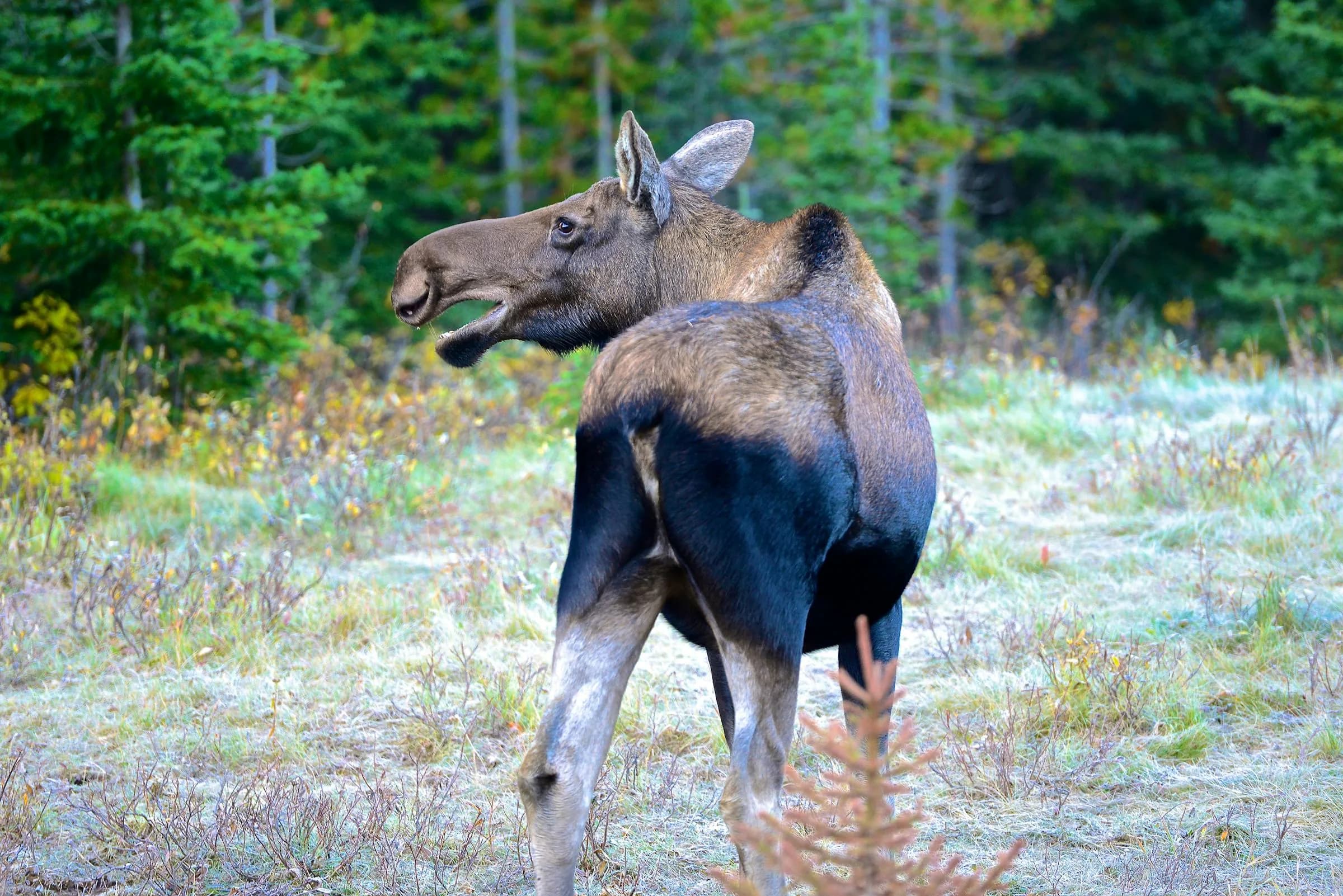
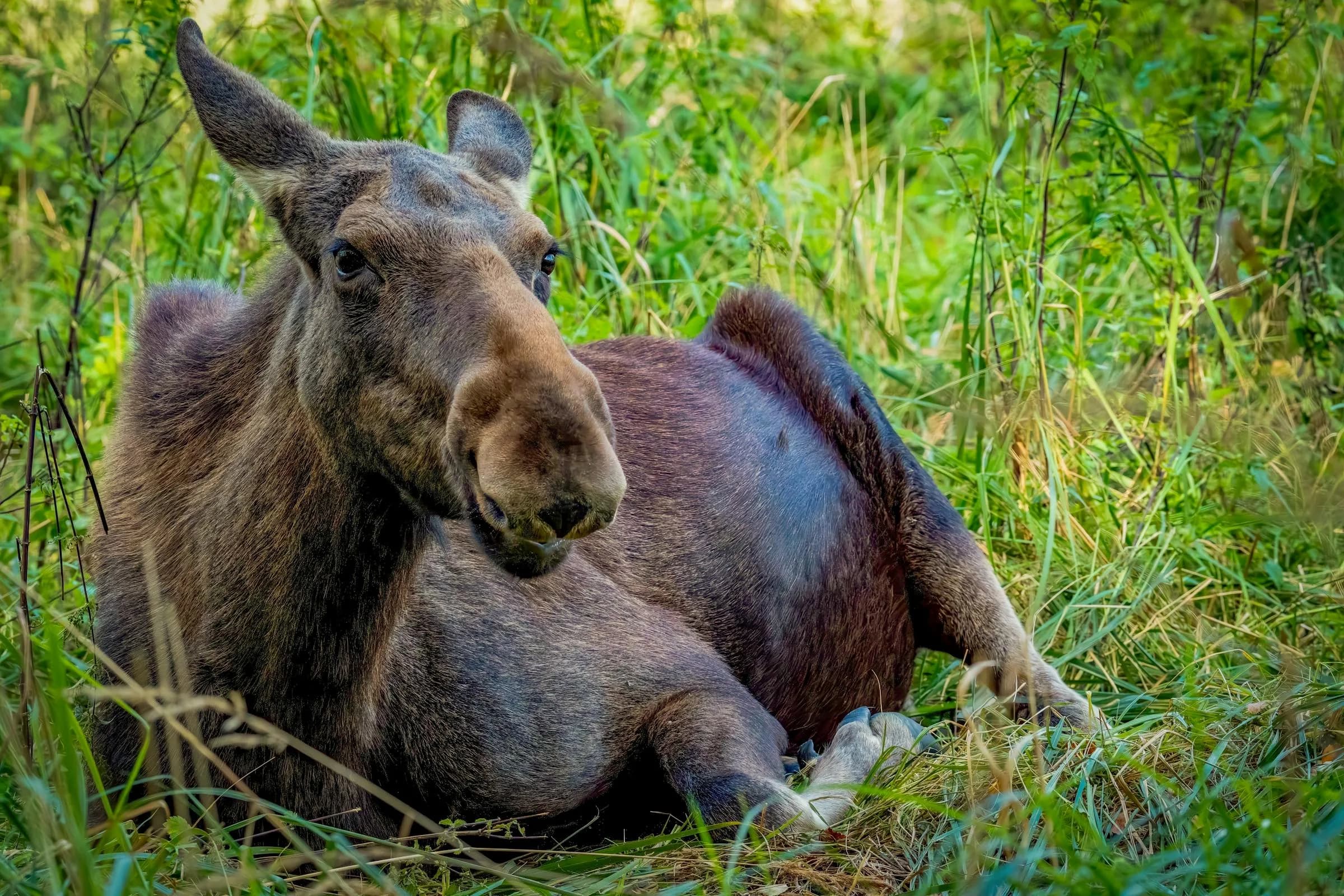
A guided moose hunt in Canada is a 7-12 day wilderness pursuit of the Canadian moose (Alces alces andersoni), the largest deer species on earth. Mature bulls stand 1.8 metres at the shoulder, weigh 450-600 kg, and carry palmated antlers spanning 40-50 inches on good British Columbia ground. The hunt is built around the rut — late September through early October — when bulls answer calls and the country comes alive. Non-residents must hunt with a licensed guide outfitter in BC, and a guided Canadian moose hunt runs USD $12,000-$20,000+ depending on region and duration. Be clear with yourself before you book: moose is a serious-commitment hunt — floatplane access, real weather, the heaviest pack-out in North American hunting. It is also, in my view, one of the finest experiences this continent offers.
I grew up in the North, in a family where hunting stories were the evening's entertainment. For Scandinavian hunters, moose — elg back home — is the species everything else is measured against, and the first time I watched a Canadian bull swing his rack through the willows toward a call, I understood why hunters cross oceans for this. Same animal, bigger stage.
Why is moose North America's defining big game hunt?
Because everything about it is large — the animal, the country, the effort, and the memory you carry out.
A moose is the largest member of the deer family on earth. A mature Canadian bull carries 20-30 kg of antler grown fresh that same year — the fastest-growing tissue of any large mammal — and sheds it every winter to start again. Standing over a bull for the first time, most hunters go quiet. Photographs do not prepare you for the scale.
Then there is the way you hunt them. During the rut, moose hunting becomes a conversation. You call, and somewhere across a river valley a bull answers — a deep grunt, the crack of antlers raking a spruce — and then he comes, sometimes silently, sometimes breaking brush like a freight train. Very few hunts on earth involve a 500 kg animal actively looking for you. Moose calling, done in a cold September valley with fresh snow on the peaks, stands alone.
And the setting seals it. Moose live in country with no fences and no roads worth the name. Hunting them means boats, floatplanes, wall tents, and weather. That is the whole point.
Where do you hunt moose in Canada?
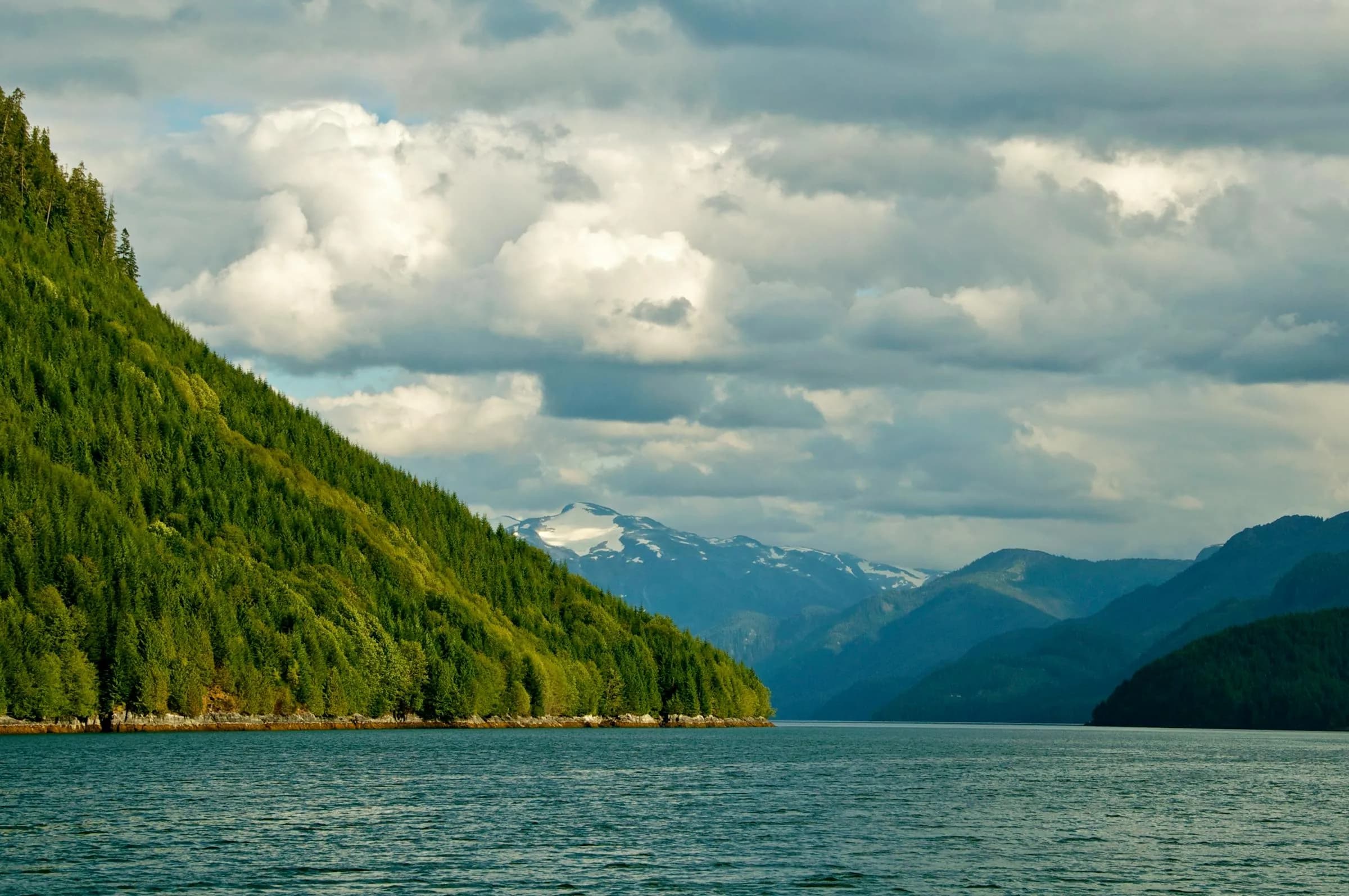
British Columbia is the heart of it, and it is where Huntica hosts. The province holds an estimated 120,000-160,000 moose, with the strongest hunting in the northern half — the Peace, Omineca, Skeena, and Cassiar regions. This is classic Canadian moose country: willow-choked river bottoms, regenerating burns and cutblocks, and subalpine basins where bulls summer before dropping into the valleys for the rut.
What makes BC special is the combination of trophy quality and structure. Guide territories are granted as defined geographic areas — one outfitter per territory, with quota set by provincial biologists. A good territory has been managed by the same family for decades, and the operator knows every wallow and crossing on it. On Huntica's Canadian Approved Ground, those are the operations we work with: vetted by a founder, hunted by us before we bring anyone else.
The honest context on the rest of Canada:
- Yukon and Northwest Territories hold the Alaska-Yukon moose — a genuinely bigger subspecies, with bulls spanning 55-65 inches. Spectacular expedition hunts, priced accordingly: USD $25,000-$40,000, often with significant charter costs.
- Alberta offers Canadian moose at lower cost — often USD $10,000-$15,000 — in mixed-wood and agricultural fringe country. Trophy quality is respectable rather than exceptional, and the experience is less remote. A fair option for a second moose; not where I would send a hunter for his first.
- Newfoundland has the densest moose population in North America and the lowest prices, but bulls run smaller-bodied with more modest antlers. Worth knowing it exists; not what this guide is about.
For the full Canadian moose experience — big country, big bulls, the rut at full volume — northern BC is the answer, and it is the ground I host.
When is moose season — and what is the rut actually like?
BC moose seasons generally run from late August or early September through late October or into November, varying by region and management unit. But the season within the season — the window that matters — is roughly 20 September to 10 October, when the rut peaks and bulls respond to calling.
Outside the rut, moose are quiet, solitary, and surprisingly hard to find for such a large animal. A bull in early September is a dark shape bedded in willows, moving at dawn and dusk, visible mostly to patient glassing.
Then the switch flips. In the last week of September, bulls abandon caution. They travel in daylight, cruise river bottoms scent-checking for cows, thrash brush, and answer sounds they would have ignored two weeks earlier. Cow moans carry across a valley, and a bull a kilometre away will lift his head, swing that rack like a ship coming about, and start walking. From first answer to final approach can take ten minutes or three hours. Your heart rate stays elevated for all of it.
The weather is part of the experience. Late September in northern BC means frost-silvered mornings, golden aspen, the first snow dusting the peaks, and days that can swing from -5°C to 18°C. It is the most beautiful window of the northern year, and you have a front-row seat.
If you can only come once, come for the last week of September. Those dates book 12-18 months out for good reason.
How do you hunt moose? Calling, spot-and-stalk, and river travel
Most BC moose hunts blend three methods, and the mix shifts with the dates and the territory.
Calling. The signature method during the rut. Your guide imitates a cow's long, nasal moan — by voice or through a birch-bark horn — and rakes brush or a canoe paddle against willows to mimic a rival bull working his antlers. Then you wait, and listen, and call again. A responding bull may grunt every few steps as he approaches, or arrive in total silence — for an animal the size of a horse, moose move through timber with unsettling quiet. Shots over calling are close: 30-100 metres, often with the bull facing you, adrenaline at maximum. When it works, there is nothing like it in North America.
Spot-and-stalk. The backbone method early and late in the season, and a daily complement to calling during the rut. You glass from ridgelines, cutbanks, and river bluffs at first and last light, picking apart willow flats and burn edges for a feeding bull or the white flash of palms. When a shooter is located, you plan a stalk with the wind and close to 150-250 metres. Moose have moderate eyesight but excellent hearing and a superb nose — the wind decides everything.
River travel. In much of northern BC, rivers are the roads. Jet boats and freighter canoes carry you between calling sites and glassing points, opening up dozens of kilometres of valley that no one walks into. The boat is transport — you hunt on foot from the bank. Some territories run horseback instead, especially toward the mountains. Either way, the daily rhythm — moving through big country, cutting fresh tracks at crossings, reading sign — is half the pleasure of the hunt.
During the rut, your guide may also sit fresh wallows — muddy pits bulls dig and scent-mark — at dawn and dusk.
What caliber for moose — and where do you place the shot?
Moose are big and strong, but they are not armour-plated. The vital zone on a broadside bull is the size of a large dinner plate. What moose demand is not exotic power; it is adequate caliber, heavy well-constructed bullets, and the discipline to place them properly and follow up.
Recommended: .300 Winchester Magnum and up. A .300 Win Mag with 180-200 grain bonded or monolithic bullets — Nosler Partition, Swift A-Frame, Barnes TTSX — is the standard North American moose rifle, flat enough for a 250-metre shot across a river bar and heavy enough for a quartering bull in the willows. The .338 Winchester Magnum with 225-250 grain bullets is even better if you shoot it well.
The Scandinavian pick: 9.3x62 Mauser. This has been the moose caliber in the Nordic countries for over a century, and I will argue for it anywhere. A 286-grain Partition penetrates like a drill, recoils less than the brochure suggests, and anchors moose with monotonous reliability inside 200 metres. If you own one, bring it.
Minimum: .30-06 Springfield with 180-200 grain premium bullets. It has taken more moose than any cartridge in history and still works — but keep shots inside 200 metres and pass on steep quartering angles.
Also excellent: .375 H&H Magnum (300-grain), .338-06, .35 Whelen, 9.3x74R for double-rifle hunters.
Shot placement: broadside, follow the back line of the front leg one-third up into the body — through both lungs and the top of the heart. Quartering away, drive for the off-shoulder. Avoid frontal shots in cover; the chest target is narrower than the silhouette suggests, and brush deflects bullets.
Two moose-specific realities to burn into memory. First, moose often show almost no reaction to a fatal hit. A bull shot through both lungs may stand for ten seconds, take three slow steps, and feed again before going down. Do not assume a miss — reload, watch, and if he is still standing, hit him again. Second, never let a hit bull reach deep water. Hurt moose head for swamps and river channels, and recovering a 500 kg animal from two metres of water is an ordeal. If a bull is standing in a pond, wait until he steps onto dry ground.
Realistic distances: 30-100 metres over calling, 150-250 metres spot-and-stalk. Practise from sticks and from sitting with a pack rest, and know your rifle to 250 metres. You rarely need more.
How do you judge a trophy bull moose?
Canadian moose are judged primarily on antler spread, palm size, and brow points — and the honest benchmarks for BC are worth knowing before you go, because the territory and the year decide what walks out in front of you.
Spread benchmarks for BC Canadian moose:
- 35-40 inches: a young to middle-aged bull. On a guided trophy hunt, you pass and keep hunting.
- 40-45 inches: a solid, fully mature bull and a genuine trophy on most BC ground. Most guided hunters take a bull in this class, and nobody should apologise for it.
- 45-50 inches: a very good bull — old, heavy-palmed, the kind a territory produces a handful of each season. This is the realistic ceiling to hope for on quality Canadian moose ground.
- 50+ inches: exceptional for the subspecies. A 50-inch Canadian moose is a different achievement from a 50-inch Alaska-Yukon bull — for andersoni, this is top-end, and bulls like this are why hunters rebook the same territory for years.
Beyond the tape: spread gets quoted, but palms and brow points make the trophy. Look for long, deep palms with 10+ points per side, and ideally double brow points — the mark of maturity. Boone & Crockett scores Canada moose on spread, palm length and width, points, and beam circumference (all-time minimum 195); a 45-inch bull with big palms can outscore a narrow 50-inch bull.
Field judging in three seconds: an alert bull's ear tips span roughly 30 inches. If the antlers extend half an ear-length past the ears on each side, he is pushing 40 inches; a full ear-length each side and you are looking at 48-50. Check that the palms rise well above the head and carry visible point length, then stop counting and listen to your guide — he has judged hundreds in this exact light and cover.
A last word on expectations: the hunter who passes three honest 43-inch bulls waiting for 50 often flies home with memories of three bulls he did not take. Decide what makes you happy, say it out loud at the campfire on night one, and let your guide work toward it.
What does a Canada moose hunt cost?
Here is the transparent breakdown. Moose is not the most expensive North American hunt — sheep hold that title comfortably — but it is a serious figure, and you should see all of it before committing.
Guided hunt cost: USD $12,000-$20,000+ for a fully guided 8-10 day Canadian moose hunt in British Columbia. The spread reflects region, access, and trophy history: a road-and-boat territory sits toward the lower end; a fly-in territory with strong 45-inch-plus history commands the upper end. The rate typically includes your guide, lodge or wall-tent accommodation, meals, in-territory transport, field prep of the trophy, and meat care. Alberta runs USD $10,000-$15,000; Yukon and NWT Alaska-Yukon moose expeditions run USD $25,000-$40,000.
Licences and tags: non-resident BC hunters need a hunting licence (approximately CAD $80) and a moose species licence (approximately CAD $250), plus a small royalty on harvest. Your outfitter arranges it all — allow roughly CAD $400-$500.
Flights: Europe to Vancouver runs €700-€1,400 return; from the US, $300-$900; from the GCC, expect $1,200-$2,500 via European hubs. Then the second leg: most northern BC territories are reached by scheduled flight to a regional strip (Smithers, Fort St. John, Prince George) plus a floatplane charter into camp. Charters are sometimes included, sometimes billed at cost — typically USD $500-$2,500 per hunter return. Ask, and get it in writing.
After the shot: meat processing and cold storage if you are taking meat (CAD $300-$600), taxidermy (a moose shoulder mount runs USD $2,500-$4,500 — it is an enormous piece), and trophy shipping (USD $2,000-$4,500 to Europe or the GCC; less within North America).
Gratuities: 5-10% of the hunt cost for your guide, plus CAD $50-$100 per day split among camp staff, is the working standard.
All-in: a self-booked BC moose hunt, flights and licences included, lands at USD $15,000-$25,000 before taxidermy. A Huntica Hosted group moose hunt builds on these same outfitter rates with a host on the ground for the full trip — quoted as one written all-in figure per hunter, with a Huntica Bespoke private trip at the upper end. Groups on our Canadian ground are kept to 2-6 hunters over 7-12 days, matched to the territory.
The realities: weather, physical demands, and meat care in the field
I respect hunters too much to sell moose as easy. Here is what the trip actually asks of you.
Weather runs the schedule. Late September in northern BC can deliver sunshine, sideways rain, and the first real snow inside the same week. Floatplanes do not fly in fog; jet boats do not run rapids in the dark. Build buffer days into your travel plans on either side of the hunt and treat a weather delay as part of the experience. Gear matters: quality rain shell, wool layers, insulated waterproof boots, and gloves you can shoot in.
The fitness bar is moderate — until the shot. Moose hunting is not sheep hunting. Days involve boat travel, glassing, and walks of 3-8 km over uneven, often soggy ground: tussocks, deadfall, willow tangles. If you can hike three hours with a light pack, you can hunt moose. The real work starts when the bull is down. A mature bull yields 200-300 kg of meat, and BC law — rightly — requires all edible portions be recovered. Quartering and packing a bull is a 3-6 hour job for two or three people, sometimes over multiple carries to the boat. Your guide and packer carry the load, but you will work, and you will sleep well that night.
Meat care is non-negotiable. Early-season days can hit 18°C, and a moose is a huge thermal mass — heat spoils meat from the bone outward if the work is slow. Good outfits get the hide off fast, quarter onto clean ground, bag everything in breathable game bags, and hang it in shade the same day. How a territory talks about meat care tells you everything about their standards. The reward is some of the finest wild meat on earth — and the moose you eat in camp two nights after the shot is a story in itself.
How do you get your moose trophy home?
The good news: moose is not listed on any CITES appendix, so no CITES permits are needed to export your trophy from Canada or import it to the EU, US, or GCC. The paperwork is standard veterinary and customs documentation.
The sequence: your outfitter handles field prep — caping, fleshing, and salting the hide, cleaning the skull and antlers. The trophy then goes to a Canadian taxidermist or export agent for treatment and crating. You choose: full taxidermy in Canada, or dip-and-ship the raw cape and antlers to your home-country taxidermist. For European and GCC hunters I usually recommend the second — easier freight, and your local taxidermist manages the final result.
Shipping realities: moose antlers are the awkward freight of the hunting world — a 45-inch rack fits no normal crate, and shoulder mounts of this species are enormous. Sea freight to Europe runs USD $2,000-$4,500 and takes 3-5 months; air freight roughly doubles the cost and cuts transit to weeks. US hunters can often drive or freight trophies across the border with a USFWS 3-177 declaration at far lower cost. For the full process — crating, brokers, documentation, timelines — read our trophy shipping and taxidermy guide.
Your rifle: Canada is straightforward for visiting hunters. You declare your firearm on arrival with a Non-Resident Firearm Declaration (form RCMP 5589), pay a CAD $25 fee, and the confirmed declaration acts as your temporary licence for up to 60 days. Non-restricted rifles only — which covers every moose rifle discussed above. Our international firearm import guide walks through the forms, airline rules, and ammunition limits.
On a Huntica trip, all of this — declaration paperwork, export documentation, taxidermy coordination, shipping follow-up until the crate reaches your door — is handled. That is the job.
What does a hosted moose hunt with Huntica look like?
I host Huntica's northern hunts personally — Canada, Greenland, New Zealand — and moose in BC is the trip I would choose for my own father.
Here is the shape of it. We meet in Vancouver or at the regional strip, depending on the territory, and fly in together. From the first briefing to the last airport goodbye, there is a Huntica host on the ground alongside the guides — not a booking agent who waved you off at the email stage, but one of us, in camp, for the whole trip. The outfitter and guides run the hunting; I run everything around it. On our Canadian Approved Ground, every operator has been hunted by a Huntica founder before we bring a single client in.
A typical day: up at 05:30, boat upriver in the grey half-light, on a glassing point as the valley wakes. Calling sequences through the morning — long silences, breath fogging, everyone listening past the river noise for a grunt. Back to camp midday, then out again from late afternoon until the light dies. Evenings are the other half of the trip: wall-tent warmth, moose tenderloin in the pan, guides' stories from thirty seasons on this water. With a group of friends — most of our Hosted moose groups are 2-6 hunters who know each other — those evenings become the part everyone talks about at the airport.
And when the remote North does what it does — a fogged-in floatplane, a rifle case delayed in Vancouver, a rut that goes quiet for three days — the host absorbs the problem. Rebooking charters, chasing the airline, restructuring the week with the outfitter so nobody loses hunting time. In country with no cell signal, having someone whose entire job is your trip is the difference between a story about a setback and a trip defined by one. We host where we hunt — that is the whole model.
Frequently Asked Questions
Do I need a guide to hunt moose in Canada as a non-resident?
In British Columbia, yes. Non-resident hunters must be accompanied by a licensed guide outfitter — or, in limited cases, by a BC resident holding a Permit to Accompany — to hunt big game. In practice, every visiting moose hunter books through a guide outfitter who holds quota in a defined territory; similar rules apply in Yukon and the Northwest Territories. This is a feature, not a hurdle: the territory system ties each outfitter's livelihood to the long-term health of one piece of ground, and the quality of guiding reflects it.
What is the success rate on a guided moose hunt?
On good northern BC territories during the rut, guided hunters take bulls on roughly 70-90% of hunts, varying with the year, the weather, and the hunter's standards. Moose is honest hunting — a warm, windy rut can suppress calling for days, and a hunter holding out for 48 inches will pass bulls others would happily take. Book the prime late-September window, stay flexible on the final inches, and the odds are firmly in your favour. Be wary of anyone who quotes you 100%.
How physically demanding is a moose hunt?
Moderate. Daily hunting involves boat or horseback travel, glassing, and walks of 3-8 km over wet, uneven ground. If you can comfortably hike for three hours with a light pack, you are fit enough; the strenuous part is the recovery after the shot, shared across the crew. Start walking regularly 8-12 weeks before the trip and practise shooting from sticks and sitting positions. Hunters in their 60s and 70s take BC moose every season.
Is moose meat good to eat — and can I take it home?
Moose is outstanding — lean, clean-flavoured, closer to fine beef than to strong venison, and a staple food across the North. US hunters can usually bring meat home across the border with the right declarations. For European and GCC hunters, exporting meat is impractical — the standard, respected practice is eating well in camp and donating the remainder to the guides, camp staff, or local families, where it is genuinely valued. Nothing is wasted.
Can I combine moose with other species?
Yes, and September timing is ideal for it. The classic BC pairing is moose with black bear, which shares the river valleys; some territories offer wolf opportunistically, and moose-and-elk combinations work where territories hold both. If the far North has its hooks in you, the natural ladder is moose in Canada one year and muskox in Greenland the next — I host both, and the two hunts could not feel more different.
When should I book a Canada moose hunt?
Twelve to eighteen months ahead. BC guide territories carry limited annual quota, and the prime calling window — the last week of September into early October — fills first, often with rebooking hunters. A long runway also gives you time for flights, the firearm declaration, gear, and shooting practice. If you want a specific territory on the rut dates, eighteen months is the honest answer.
Tell us where you want to go
If moose has been living in your imagination — the grunt across the river, the rack swinging through golden willows, the wall-tent evenings in country without roads — the next step is a conversation. Tell us where you want to go, and I will walk you through what a hosted moose hunt looks like on the British Columbia ground we trust, and which weeks I would fight for. No brochures. Just two hunters talking about the North.