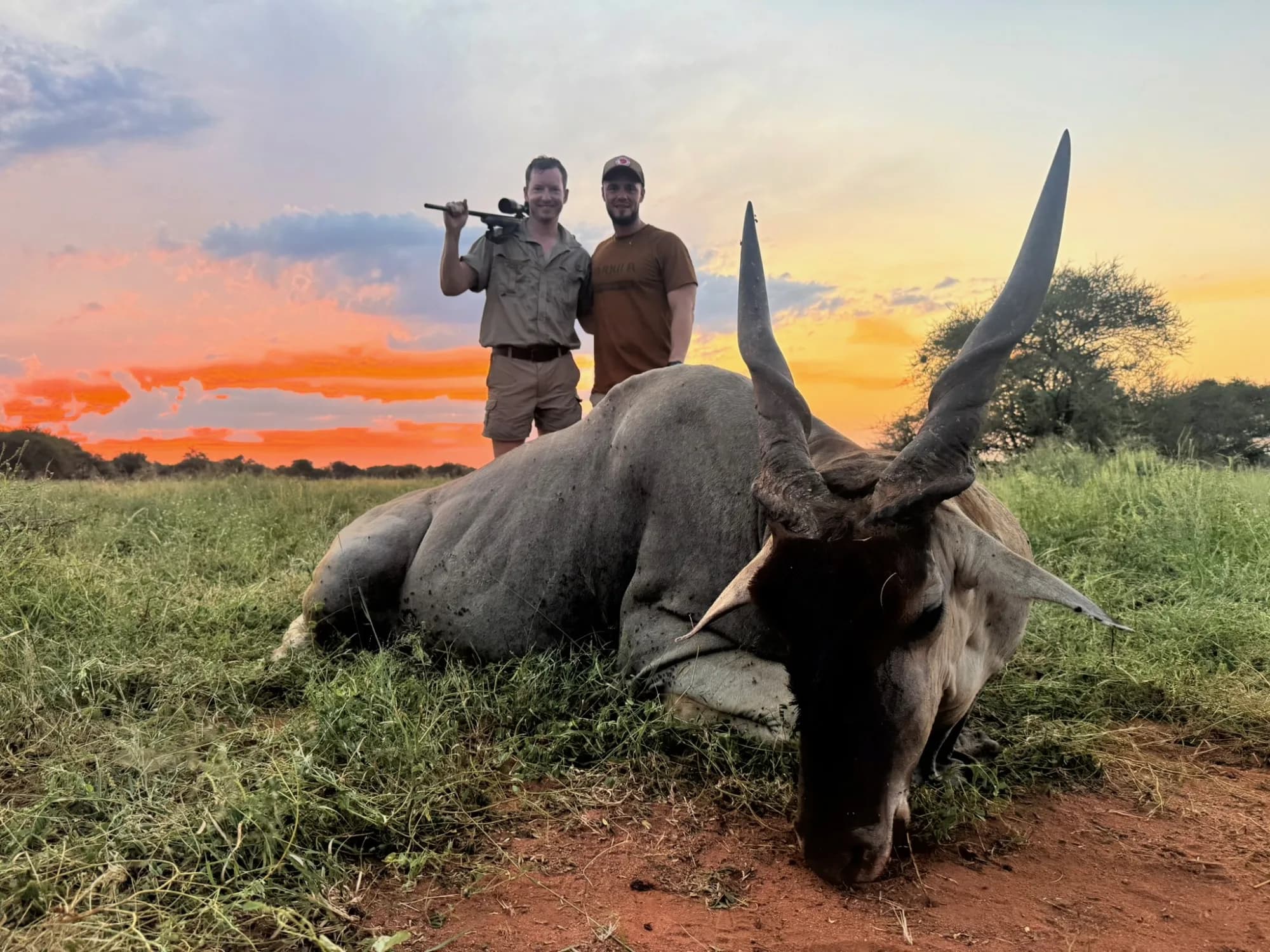
Nyala hunting in South Africa means still-hunting the thickets and riverine bush for Tragelaphus angasii, the most visually dramatic of the spiral-horned antelope and, in my experience hosting hunters across this country, the one trophy that stops conversation dead when it comes off the skinning rail. A mature bull stands just over a metre at the shoulder, weighs roughly 100-125 kg, and carries slate-grey to charcoal hair set off by up to a dozen thin white vertical stripes, a shaggy fringe running from throat to belly, and horns that spiral out in a wide, ivory-tipped sweep. Put him next to his own females and young — chestnut-red, striped, hornless, built like a different species entirely — and you understand why nyala carries the reputation it does.
This is not the kudu hunt. Where a kudu bull demands a long spot-and-stalk across open Karoo or Eastern Cape valley country, a nyala hunt is close, patient, and fought on the animal's terms inside dense coastal bush. Different skill, different terrain, same result: one of the finest trophies on the continent, and — as I noted in our kudu hunting guide — one of the most common premium additions hunters build into a broader South African plains-game trip.
What makes nyala hunting special
Two things make nyala the trophy hunters ask about by name: the animal's appearance, and the difficulty of getting close to one.
Nyala are the most sexually dimorphic of Africa's spiral-horned antelope. Only the bulls carry horns — a loose double-spiral, 60-83 cm (24-33 inches) along the curve, tipped in cream-coloured ivory and flaring outward at the ends. Bulls carry a long, shaggy fringe of dark hair down the throat, chest, and belly, and a mane along the spine that stands up when the animal is alert or agitated. Cows and calves are a completely different colour — bright chestnut to tawny, with the same faint white stripes but no horns, no fringe, no mane. Walk onto ground with a nyala herd and a first-timer will often ask if they are looking at two different species. That contrast is the whole appeal.
The second reason nyala earns its reputation is habitat. Nyala live in dense thicket, riverine woodland, and thick bushveld edge cover — country built for hiding, not for glassing. They are naturally shy, spend long stretches standing motionless when they sense you, and lean nocturnal or crepuscular wherever hunting pressure or human activity is high. You do not stalk a nyala across open ground from 400 metres the way you would a kudu bull. You work slowly through thick cover at 40-120 metres, reading tracks and rustling leaves, often from a hide near water or along a known thicket trail, waiting for a bull to commit to the open for the few seconds it takes to settle a shot. It is a still-hunter's trophy, not a distance-runner's.
Add a nyala to a kudu-and-plains-game safari and you get contrast rather than repetition: a different habitat, a different hunting method, and a trophy that looks nothing like anything else on the wall.
Where to hunt nyala in South Africa
Nyala's native range in South Africa is the Zululand bushveld of northern KwaZulu-Natal — the country around Pongola, Mkuze, and Hluhluwe, where dense riverine thicket along the coastal lowveld has held wild nyala populations for generations. This is still the premier nyala destination in the country and where you will find the deepest, most consistent trophy quality on free-range or low-fence ground.
Nyala have also been introduced widely onto suitable thicket and bushveld ground well beyond KwaZulu-Natal. The Eastern Cape's river valleys and dense spekboom and euphorbia thickets — much of it the same country that produces the region's famous kudu — hold strong, well-managed nyala populations today, and a nyala addition is one of the most common premium trophies booked alongside kudu on Eastern Cape ground. Limpopo's lowveld thornveld, further north toward the Mozambique border region, is the third major nyala area, generally producing thicker-based, tighter-curled trophies in denser bush at closer range.
Huntica's own South African anchor is Magersfontein, our approved ground in the Northern Cape near Kimberley — dry Karoo scrub and open bushveld built for gemsbok, springbok, sable, roan, and buffalo. That is not nyala habitat; nyala needs the thicket and river cover of KwaZulu-Natal, the Eastern Cape, or Limpopo. When a Huntica guest wants nyala on the trophy list, we build it into the itinerary as an extension onto Eastern Cape or KwaZulu-Natal ground with a favored partner outfitter who works that terrain daily — the same way we handle kudu and Cape buffalo on ground outside Magersfontein.
When is nyala hunting season
South Africa's hunting season runs March through October. Within that window, nyala hunting has a genuinely useful sweet spot rather than a single "best" month.
The dry winter months — roughly May through September — are when most experienced outfitters recommend booking a nyala hunt. Dense thicket thins as the bush dries out, visibility through cover improves meaningfully, and nyala concentrate closer to permanent water, which narrows down where to look for them. The nyala rut typically peaks in the cooler autumn and early winter months (roughly March through June), when bulls move more in daylight, posture and vocalize toward rivals, and occasionally push into more open ground than they would otherwise tolerate — all of which works in a hunter's favour.
Put those two windows together and May and June stand out as the strongest combination: rutting activity plus thinning winter cover. Early morning and last light are consistently the most productive hours of the day, since nyala move to feed and drink at dawn and dusk and rest deep in shade through the middle of the day.
| Period | Conditions | Why it matters for nyala |
|---|---|---|
| March-April | Bush still thick and green, rut building | Harder visibility, but bulls less pressured |
| May-June (peak) | Dry, thinning cover, rut at its peak | Best combination of visibility and bull movement |
| July-August | Driest, coolest, game concentrated at water | Strong visibility; bulls more wary post-rut |
| September-October | Warming, some new growth returning | Still productive; bush begins to thicken again |
What caliber for nyala
Nyala are a mid-sized antelope taken at genuinely close range in thick cover, and caliber selection reflects that reality more than it reflects raw stopping power. Shots typically break at 40-120 metres, most inside 80 metres, often through gaps in the brush rather than in the open.
Recommended: .270 Winchester with a 130-150 grain bonded bullet is an excellent all-round choice for nyala-weight antelope at typical bushveld ranges, and it is one of the most common calibers used across South African plains-game hunts generally. The .308 Winchester with a 165-grain bonded projectile is arguably the most universally recommended nyala caliber — flat-shooting enough for the open moments, more than sufficient for the close ones. The .30-06 Springfield with a 165-180 grain bonded load does the same work with a slightly heavier bullet and is a favourite among Professional Hunters across the region for its combination of penetration and manageable recoil.
Also effective: 7mm-08 Remington, .303 British, and 7x57 Mauser — all deliver adequate energy on nyala at typical thicket ranges without excessive recoil, which matters when shots come fast and off-hand through brush.
Bullet choice matters more than magnum performance here. A controlled-expansion or bonded bullet holds together on the frequent quartering and moving shots that thicket hunting produces — a nyala rarely stands still and broadside for long. Standard cup-and-core deer bullets can work but leave less margin on an animal moving through cover at an angle.
If your trip also includes kudu, buffalo, or other larger species, see our kudu hunting guide for caliber recommendations that will double up cleanly across both species — a .300 Winchester Magnum or .375 H&H handles nyala without any compromise if you are already carrying one for bigger game.
Shot placement on nyala
Shot placement matters more on nyala than on almost any other plains-game species, simply because you rarely get the clean, unobstructed broadside look that open-country hunting provides. Branches, low light in deep shade, and an animal that is already half-turned to leave are the norm, not the exception.
The heart/lung shot (broadside): Aim behind the front leg's shoulder crease, roughly a third of the way up the body from the brisket. This is the shot every experienced PH is waiting to give you the go-ahead on, and it puts a bull down quickly with minimal tracking.
Quartering away: A common presentation in thicket hunting, since nyala often move off at an angle rather than stopping square. Aim for the far shoulder and hold for a bullet that will travel through both lungs before exiting — this is where a bonded or monolithic bullet earns its keep.
Quartering toward or partially screened: Pass on it. A nyala half-hidden behind a branch or facing you at an angle in low light is not a shot worth forcing. Wait for the animal to clear, or let it go — there will be another chance, and thicket country rewards patience over aggression.
The reality in the field: Expect several minutes of watching a bull through gaps in the brush before a clean opportunity presents itself, sometimes at surprisingly close range. Trust the PH's read on the wind and the animal's body language — thicket hunting is a team effort between hunter and tracker far more than open-country stalking is.
Trophy scoring and what makes a good nyala
Nyala are scored on horn length using two common systems. Safari Club International (SCI) measures total horn length plus base circumference on both horns and combines them into a single score. Rowland Ward measures only the length of the single longest horn.
What the numbers mean:
- Rowland Ward minimum entry: 27 inches on the longest horn.
- SCI minimum entry: roughly 63 inches combined (both horn lengths plus base measurements).
- Representative mature bull: 25-27 inches per horn. This is what most hunters take on well-managed ground and is a genuine, honest trophy.
- A very good bull: 28-30 inches per horn — an older animal with a fuller spiral and heavier bases, sitting right around the line most outfitters call "exceptional."
- A record-class bull: 31-32 inches per horn approaches the Rowland Ward record range. These are rare, generational animals on any ground.
How to field-judge a nyala bull: Look at the number of twists in the spiral first — a mature bull typically shows close to two full turns, while a younger animal shows a single open curl. Ivory colouring on the horn tips (the pale, worn last few inches) indicates age. Base thickness and a full, dark, shaggy body fringe are strong secondary signs of maturity; young bulls look leaner and lighter through the chest and throat mane.
Because nyala hunting happens at close range in thick cover, you often get less time to judge a bull than you would glassing a kudu from 300 metres. Lean on your PH's call — this is exactly the kind of decision a favored partner outfitter with generations of experience on the same ground is built for.
What does a nyala hunt cost
Nyala hunting costs in South Africa follow the same structure as any plains-game trophy: a daily rate for the hunt itself, plus a trophy fee for the animal.
Daily rates: $350-$500 per day across South African plains-game destinations, covering the PH, trackers, vehicle, meals, and accommodation — the same range that applies to a kudu-focused hunt on comparable ground. A dedicated nyala hunt typically needs 3-5 focused hunting days; most hunters roll nyala into a broader 7-10 day plains-game safari rather than booking it alone.
Nyala trophy fee: roughly $2,200-$4,000 depending on the region, the outfitter, and the size tier — many operations price nyala under 28 inches near the lower end of that range and 28+ inch bulls toward the top. On Huntica trips, a nyala addition to a plains-game itinerary is quoted with your species list — see nyala as an Eastern Cape addition in our kudu hunting guide.
Total trip cost (self-booked): For a 7-10 day KwaZulu-Natal or Eastern Cape plains-game safari including nyala, 2-4 other species, daily rates, and trophy fees, before flights and taxidermy: roughly $6,000-$11,000 per hunter is a realistic range once you add the components above together.
With Huntica hosting: a hosted Huntica plains-game trip is quoted as one written all-in figure, excluding international flights — the outfitter cost plus our hosting fee for the planning, the host on the ground, and everything that gets handled before you ask. A nyala-focused KwaZulu-Natal or Eastern Cape itinerary, built as a Huntica Bespoke trip, sits toward the higher end given the trophy fee tier — your host will walk you through the real number for your specific species list rather than quoting a fixed figure up front. See our full breakdown of hunting safari costs for how nyala compares to other species across destinations.
What is not included: international flights, dip-and-pack and taxidermy, firearm import paperwork, travel insurance, and gratuities for the PH and camp staff. Our trophy shipping and taxidermy guide covers what it costs to get a nyala shoulder mount or cape home once the hunt is over — the coloured cape and the striking dark mane make nyala one of the more visually dramatic mounts to bring back, and it is worth planning for the cost of a shoulder mount rather than a skull mount alone.
What a hosted nyala hunt looks like with Huntica
A nyala hunt is a different rhythm from a kudu hunt, and it is worth knowing that going in. Instead of long glassing sessions and multi-hour stalks across open valleys, you spend your mornings and evenings moving slowly and quietly through thick riverine bush, often working known trails and waterholes with a tracker reading sign a few steps ahead of you. Some days you will sit a hide overlooking water for an hour at a time. Other days you still-hunt a thicket edge at the pace of a slow walk, stopping every few steps to look and listen.
This is where a host earns his keep in a different way than on open-country kudu ground. Thicket hunting rewards local knowledge of specific trails, wallows, and feeding routes far more than it rewards raw fitness or long-range shooting — which means the outfitter and tracker relationship matters even more than usual. On a Huntica trip, your host is there managing exactly that: making sure you are matched with a favored partner who has walked this specific ground for years, adjusting the plan by the hour as wind and animal movement shift, and keeping the pace right for a hunt that lives and dies on patience rather than distance covered.
Typical structure on a combined itinerary: most Huntica guests add 3-5 focused nyala days onto a broader 7-10 day South African plains-game trip, hunting nyala in the early morning and last light when movement peaks, and using midday for other species, camp time, or rest. It is a natural complement to kudu, bushbuck, and other Eastern Cape or KwaZulu-Natal thicket species, and it gives a group real variety across a single trip rather than one long stretch of the same terrain and technique.
Frequently Asked Questions
What is the difference between nyala and mountain nyala?
They are two entirely different species. The nyala covered in this guide (Tragelaphus angasii) is a lowland, thicket-dwelling antelope found across KwaZulu-Natal, the Eastern Cape, and Limpopo in South Africa. The mountain nyala (Tragelaphus buxtoni) is a separate, much rarer species found only in the highlands of Ethiopia, hunted under a completely different set of conditions, permits, and logistics. If someone mentions a South African nyala hunt, they mean the lowland species described here.
What is the best caliber for nyala?
The .308 Winchester and .30-06 Springfield, both loaded with a 165-180 grain bonded bullet, are the most widely recommended calibers for nyala given the close ranges (typically 40-120 metres) and thick cover involved. The .270 Winchester with a 130-150 grain bonded bullet is also an excellent, slightly lighter-recoiling option. If your trip pairs nyala with kudu or other larger plains game, a .300 Winchester Magnum or .375 H&H covers both without compromise.
When is the best time of year to hunt nyala?
May and June typically offer the strongest combination of conditions: the nyala rut is at its peak, and winter is thinning the bush enough to improve visibility in the thickets nyala prefer. The broader dry season, roughly May through September, is generally favoured over the wetter early season because thinner cover and water-dependent movement make bulls easier to locate. Early morning and last light are consistently the most productive hours regardless of month.
How much does a nyala hunt cost in South Africa?
Daily rates for South African plains-game hunting typically run $350-$500 per day, and nyala trophy fees generally fall in the $2,200-$4,000 range depending on the region and the bull's size tier. Most hunters add nyala to a broader 7-10 day plains-game safari rather than booking it alone, which brings the realistic self-booked total to roughly $6,000-$11,000 before flights and taxidermy. On a hosted Huntica trip, a plains-game itinerary including nyala is quoted as one written all-in figure, with the exact number depending on your full species list and trip length.
Do I need CITES paperwork to bring a nyala trophy home?
No. Nyala is not listed on any CITES appendix and is classified Least Concern by the IUCN, so no CITES export or import permit is required for a nyala trophy. You will still need standard South African export documentation (veterinary and dip-and-pack certification) and, for US hunters, a routine USFWS Form 3-177 declaration on arrival — the same paperwork required for kudu, gemsbok, and most other non-dangerous-game plains species.
Can nyala be combined with kudu or other plains game on one trip?
Yes, and it is one of the most common combinations in South African hunting. Nyala shares habitat with kudu, bushbuck, and impala across much of the Eastern Cape and KwaZulu-Natal, and hunters routinely build a single 7-10 day trip around both species plus 2-4 supporting animals. Because nyala hunting happens in thicket at close range and kudu hunting happens in more open country at longer range, the two species also give a trip genuine variety in terrain and technique rather than repeating the same hunt twice. See our kudu hunting guide for how the two typically combine on Eastern Cape ground.
Tell us where you want to go
Nyala is the trophy that makes people stop and ask what it is — the colour, the fringe, the spiral horns unlike anything else on the wall. If you are building a South African plains-game trip and want nyala on the list alongside kudu, gemsbok, or a species like sable, tell us where you want to go, and I will walk you through what ground fits, what season makes sense, and what a hosted trip built around your species list actually looks like. No brochures, no price lists. Just a straight conversation between hunters about Africa's most striking antelope.