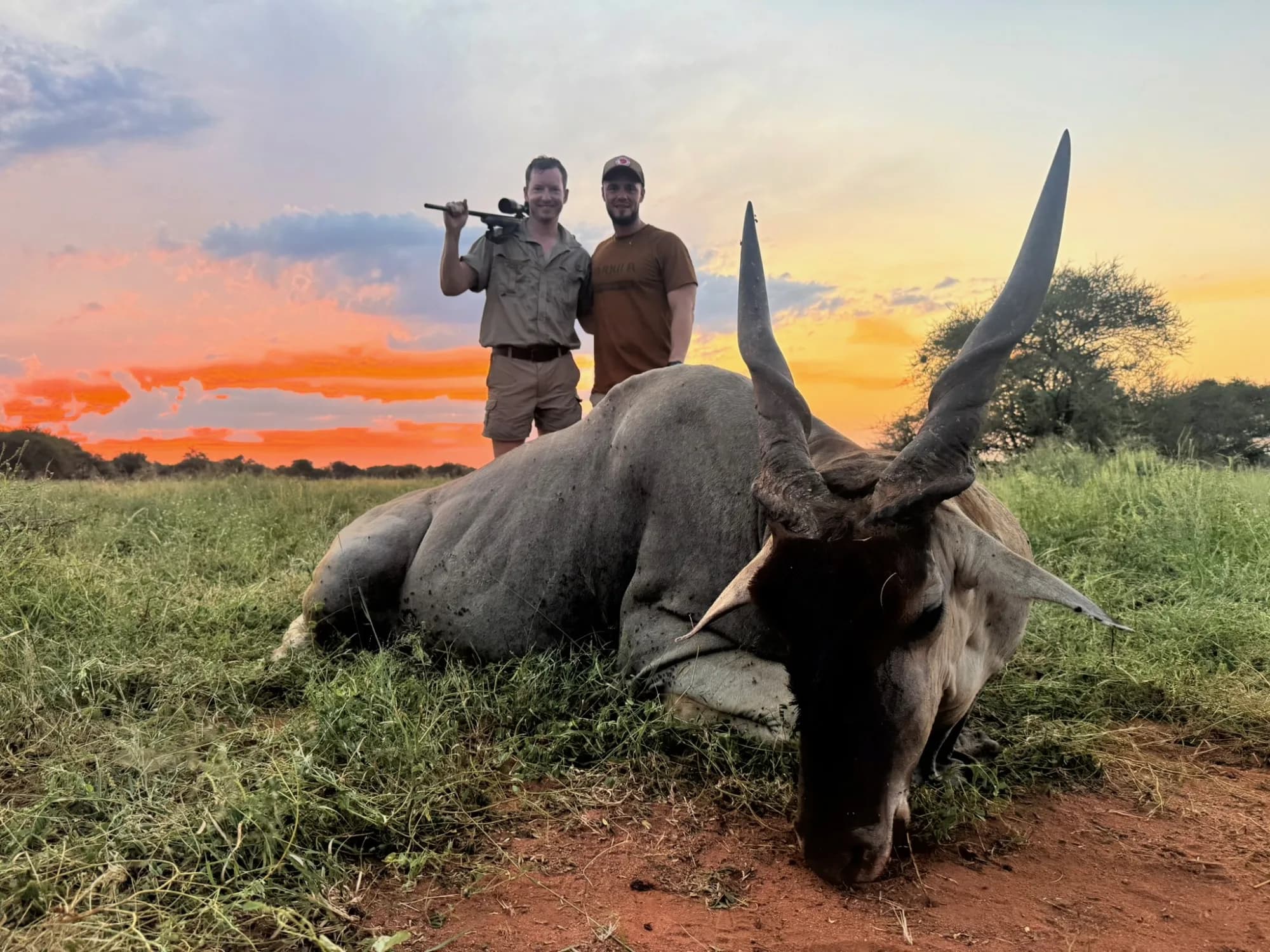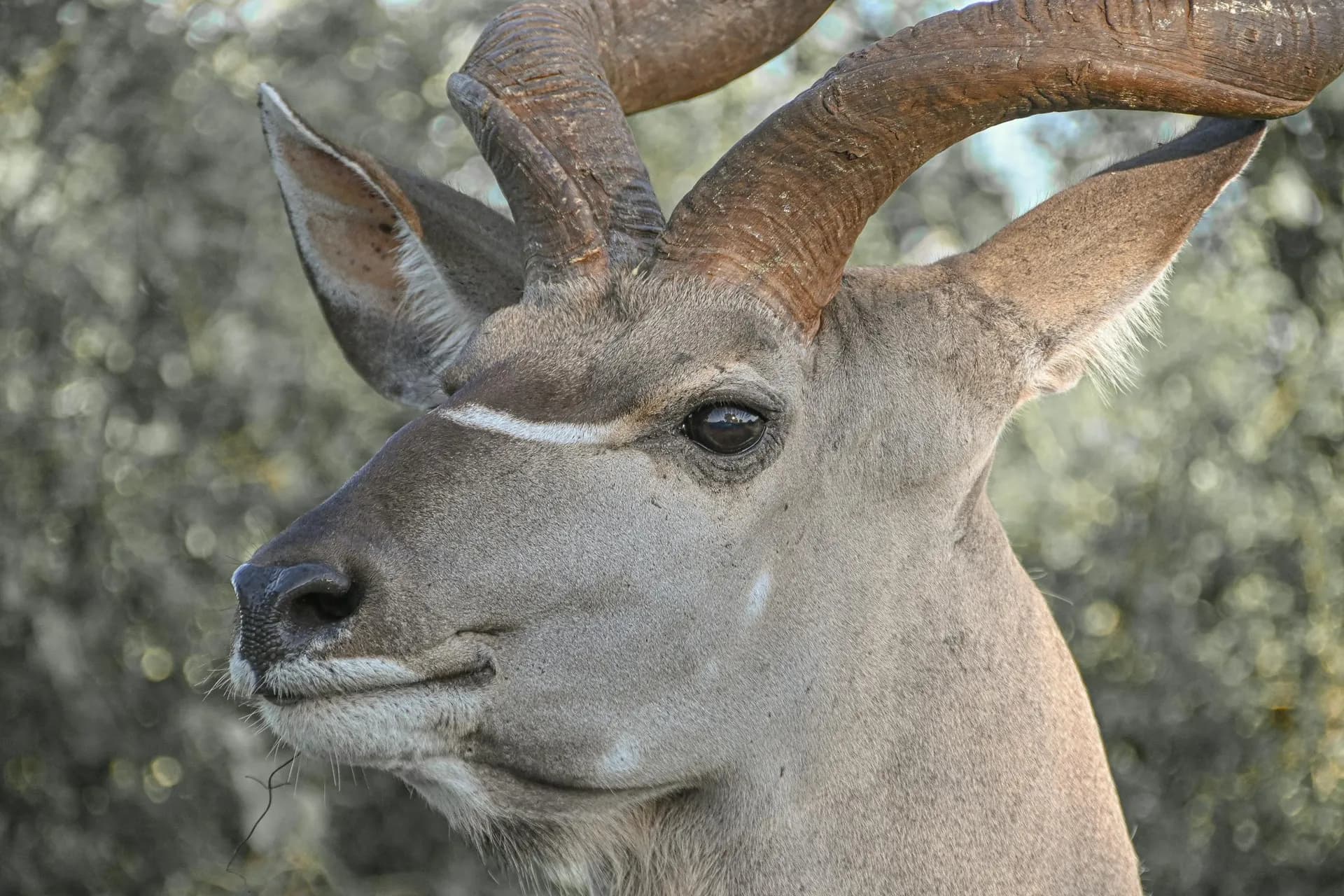
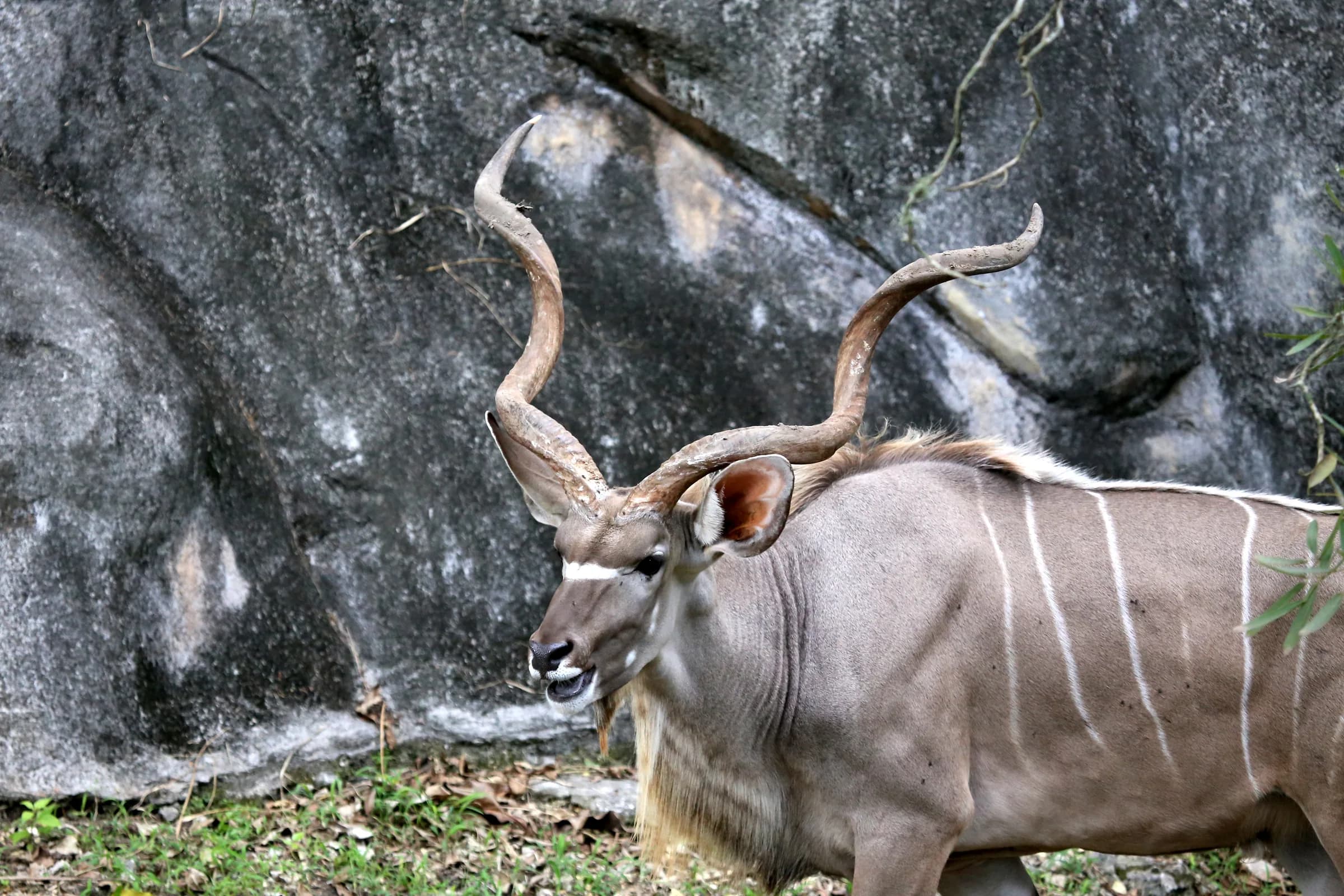
Kudu hunting in South Africa is a spot-and-stalk pursuit of the greater kudu (Tragelaphus strepsiceros), the largest of the spiral-horned antelopes and the most sought-after plains game trophy on the African continent. Mature bulls stand 1.5 metres at the shoulder, weigh 250-315 kg, and carry spiraling horns that can exceed 60 inches along the curve. The Eastern Cape province produces the finest free-range kudu trophies in South Africa, with mature bulls averaging 48-53 inches on well-managed ground.
I've hunted kudu on this ground my entire life — seven generations of my family on South African soil. Kudu earned the Grey Ghost nickname honestly. A 300 kg bull can vanish into spekboomveld so quietly you'd swear the bush swallowed him whole. They have the sharpest hearing of any plains game species and an instinct for using terrain that makes them the most challenging free-range trophy in southern Africa.
What makes kudu hunting special?
The greater kudu is the centrepiece species on nearly every Eastern Cape plains game safari. No other plains game animal combines the physical presence, the challenge, and the sheer beauty of a mature bull. Those ivory-tipped spiraling horns — two and a half to three full turns — are the most recognizable trophy silhouette in African hunting.
The reputation rests on more than aesthetics. Kudu are exceptionally difficult to hunt well. Their hearing is their primary defence — a bull can detect a careless footstep on dry leaves at 100 metres. They inhabit thick bush — river valleys choked with euphorbia, spekboom thickets, dense thornveld on steep hillsides — and use that cover intelligently. A kudu does not run blindly when spooked. He moves downhill into cover, stops to listen, then ghosts away through vegetation you cannot see through, let alone shoot through.
Every kudu taken on foot, in fair chase, represents hours of stalking, blown approaches, and patience. No shortcuts. That is the appeal.
Where to hunt kudu in South Africa
The Eastern Cape is the premier kudu hunting destination in South Africa, and it is not close. The province's combination of topography, vegetation, and land management produces the highest density of mature, free-range kudu bulls in the country. The specific regions to look for are the Great Fish River valley between Cradock and Grahamstown, the Karoo fringe around Graaff-Reinet and Somerset East, and the coastal hinterland between Fort Beaufort and Adelaide. These areas produce consistently strong trophy quality — 50-55 inch bulls are realistic targets on well-managed ground.
Quality kudu concessions across South Africa typically cover 5,000 to 15,000 hectares of mixed bushveld and Karoo scrub. Kudu have large home ranges — a mature bull may cover 3,000 to 5,000 hectares in a season — and you need enough ground to hold a resident population. On Huntica Approved Ground, our Magersfontein concession runs ~7,000 hectares plus surrounding ground in the Northern Cape, with consistent kudu, sable, and roan populations.
Other provinces offer kudu with different characteristics. Limpopo produces big-bodied bulls in denser bushveld where shots are closer (60-120 metres) and shorter in duration. KwaZulu-Natal has good populations in the Zululand thornveld around Hluhluwe and Mkuze. The Northern Cape near Kimberley — where Huntica also operates on approximately 7,000 hectares — holds kudu alongside sable, roan, and buffalo.
For a dedicated kudu hunt with Huntica, Magersfontein in the Northern Cape is where I host every serious hunter.
When is kudu hunting season?
South Africa's hunting season runs from March through October, covering the Southern Hemisphere's autumn, winter, and early spring. Kudu can be hunted throughout this entire window, but the timing you choose makes a significant difference to your experience and your trophy.
March-April (early season): The bush is still green from summer rains, vegetation is dense, and kudu are well-fed and relaxed. Visibility is lower, which makes glassing harder but stalking easier — bulls are less skittish before hunting pressure builds. Horns are fully hardened after the velvet shed in late February. Temperatures are comfortable: 18-28°C during the day, 10-15°C at night.
May-July (peak season — the rut): This is when I recommend most kudu hunters come. The kudu rut typically peaks in May and June in the Eastern Cape, when bulls are actively seeking cows and moving more during daylight hours. A rutting kudu bull drops his guard — not entirely, but enough. He vocalizes with a deep, barking cough that carries across the valley. He stands on ridgelines scent-checking for cows. He enters open ground he would never cross in March. Vegetation thins as winter dries the bush, improving visibility dramatically. Shot distances extend to 150-250 metres as sightlines open up. Temperatures drop: 15-22°C days, 2-8°C mornings. This is prime time.
August-October (late season): The bush is at its driest. Game concentrates near water sources, which can make locating animals easier but also pushes herds onto smaller areas of ground. Post-rut bulls are wary, solitary, and harder to approach. By October, spring growth begins and temperatures climb again. Late season hunts can be productive, but they require more patience and longer walks.
For a first kudu hunt, book May or June. The rut tips the odds meaningfully in your favour without compromising the challenge.
What caliber for kudu?
Kudu are big-bodied, tough-skinned animals with heavy shoulder bones and a deep chest cavity. A mature bull weighs 270-315 kg, and a quartering-away shot through the off-shoulder requires a bullet that can penetrate 40-50 cm of muscle and bone before reaching the vitals. Caliber selection matters here more than it does for impala or warthog.
Minimum: .270 Winchester with 150-grain premium bullets. This works, but it is the floor. There is no margin for imperfect shot placement, and quartering shots through the shoulder become risky.
Recommended: .300 Winchester Magnum or .30-06 Springfield. These are the two most popular kudu calibers among Professional Hunters in the Eastern Cape, and for good reason. A .300 Win Mag loaded with 180-grain Barnes TTSX, Swift A-Frame, or Nosler Partition delivers the penetration and energy transfer needed for clean, consistent results at Eastern Cape distances. The .30-06 with 180-grain bonded or monolithic bullets does nearly the same work at ranges under 200 metres.
Also excellent: 7mm Remington Magnum (160-175 grain), .308 Winchester (180 grain bonded), .338 Winchester Magnum.
Not overkill: If your safari includes Cape buffalo, sable, or eland alongside kudu, bring a .375 H&H Magnum. I have taken dozens of kudu with a .375, and with 300-grain Swift A-Frames or Barnes TSX, it is one of the most effective kudu calibers I have used. The .375 is the legal minimum for dangerous game in South Africa and handles plains game beautifully — you just carry one rifle for the entire trip.
Bullet selection matters more than caliber. Avoid thin-jacketed cup-and-core bullets designed for deer. Kudu require controlled-expansion or monolithic projectiles that hold together through heavy bone. My shortlist: Barnes TTSX, Swift A-Frame, Nosler Partition, and Federal Trophy Bonded Tip. Standard soft-points fragment too easily on the kudu's heavy shoulder blade.
Typical shot distances: 80-250 metres in the Eastern Cape, with most opportunities between 120 and 200 metres. Know your point of impact at 200 metres before you arrive.
Shot placement on kudu
Shot placement on kudu is everything. A well-placed 165-grain .308 will anchor a kudu bull cleanly. A poorly placed 300-grain .375 will result in a long tracking job through impossible bush.
The heart/lung shot (broadside): Place the crosshair directly behind the shoulder crease — the vertical fold of skin where the front leg meets the body — and one-third of the way up from the brisket (the bottom of the chest). This puts the bullet through both lungs and the top of the heart. A kudu hit here will typically run 30-80 metres and go down. This is the shot you wait for.
Quartering away: Aim for the off-shoulder. The bullet needs to travel through the rear lungs and exit through the opposite shoulder — 40+ cm of penetration. Use only premium bonded or monolithic bullets of adequate weight.
Quartering toward: Risky. Thick shoulder bone and a narrow window to vitals. I would only take this inside 120 metres with a .300-class rifle and controlled-expansion bullet. First-timers should pass and reposition.
Frontal shot: Do not take it. The kudu's thick boss and heavy skull protect the brain from the front, the chest presents a narrow target, and a hit an inch off-centre results in a jaw wound or a lost animal.
The reality in the field: Kudu rarely present textbook broadside shots in the Eastern Cape bush. You will see bulls at awkward angles — half-screened by spekboom, turning away, standing in shadow. The discipline is waiting. When the bull steps clear and turns broadside, you have 3-5 seconds. Make it count.
Trophy scoring and what makes a good kudu
Kudu trophies are scored by measuring the length of each horn along the outside spiral from base to tip, then adding the two measurements together. The Safari Club International (SCI) method — the most widely used scoring system for African game — records the total combined length in inches. The Rowland Ward method measures only the longest horn.
What the numbers mean:
- SCI minimum entry: 121 inches (combined). This represents a mature bull but not necessarily an old one.
- Average mature bull (Eastern Cape): 48-53 inches per horn, or 96-106 inches SCI combined. This is what most hunters take on a well-managed concession and it is a genuine trophy.
- A good bull: 53-55 inches per horn (106-110 SCI). This is an older animal, typically 8-10 years old, with deep curls and ivory tips showing wear.
- An exceptional bull: 55-58 inches per horn (110-116 SCI). Top-end Eastern Cape genetics. These bulls exist on quality ground but are not common. Expect to invest 4-6 days of focused kudu hunting to find one.
- Record-class: 60+ inches per horn (120+ SCI). These are generational animals. The SCI world record greater kudu exceeds 150 inches combined. A 60-inch bull is a once-in-a-career trophy anywhere in Africa.
How to field-judge horn length:
This takes years of practice, but the basic landmarks: a kudu bull's ear tips are roughly 26-28 inches apart when alert. If the horn tips extend above the ear tips when viewed from the front, the bull is likely 48+ inches. If the second curl (the deeper spiral) is clearly visible and the tips flare outward, you are looking at 52+ inches. Deep ivory tips — the last 4-6 inches of horn that are pale and smooth — indicate maturity and typically correlate with length.
Spread and symmetry affect visual impression but are not scored by SCI. A wide-spread bull with mediocre horn length will look more impressive in the field than a tight, long-horned bull. Trust your PH — he has judged thousands.
Eastern Cape vs. Limpopo: Eastern Cape kudu tend toward longer horns with wider spreads due to open terrain and valley nutrition. Limpopo kudu have thicker bases and tighter spirals. Both produce world-class trophies, but the Eastern Cape has the edge for consistent free-range quality.
What does a kudu hunt cost?
Kudu hunting costs in South Africa break down into daily rates, trophy fees, and associated trip expenses. Here is a realistic, transparent breakdown.
Daily rates: $350-$500 per day in the Eastern Cape, covering accommodation, meals, PH services, trackers, and field vehicles. A quality kudu hunt requires a minimum of 5 days in the field — 7 days is the norm for a plains game safari that includes kudu alongside other species. Daily rate subtotal: $2,450-$3,500 for a 7-day hunt.
Kudu trophy fee: $1,500-$3,500 depending on the area, the quality of the ground, and the outfitter. On well-managed Eastern Cape concessions with mature bulls averaging 50+ inches, expect trophy fees at the higher end of that range. Some operations offer tiered pricing based on horn length — for example, under 50 inches at $1,800, 50-55 inches at $2,500, over 55 inches at $3,500.
Additional species: Most hunters add 3-5 other plains game species to a kudu-focused trip. Impala ($400-$600), blue wildebeest ($800-$1,200), warthog ($350-$500), bushbuck ($1,200-$2,000), and nyala ($2,500-$4,000) are the common additions on Eastern Cape and Northern Cape ground. Additional trophy fees typically total $2,000-$5,000.
Total trip cost (self-booked): For a 7-day Eastern Cape plains game safari including kudu, 3-4 other species, flights from Europe or the US, daily rates, and trophy fees: $6,000-$12,000 per hunter before taxidermy and shipping.
With Huntica hosting: A Huntica Hosted group kudu hunt in the Eastern Cape is quoted as one all-in figure per hunter. A Huntica Bespoke private trip for 2-4 hunters sits at the higher end. The number depends on group size, species list, and specific ground. Includes daily rates, hosting, trophy fees for the agreed species list, all transfers, accommodation, meals, and drinks at the lodge. Read our full breakdown of hunting safari costs for how these numbers compare across destinations.
What is not included: International flights (€800-€2,500 from Europe, $1,200-$3,000 from the US), taxidermy and shipping (see next section), firearm import permits (approximately ZAR 200), travel insurance (€200-€500), and gratuities (industry standard: 8-10% of daily rate and trophy fees for PH; €15-€25/day for trackers and camp staff).
Taxidermy and getting your kudu home
A kudu bull's head and horns are one of the most impressive wall mounts in all of hunting. Getting that mount from the skinning shed in the Northern Cape to your wall at home involves several steps and costs worth understanding upfront.
Mount options:
- Shoulder mount: Full head, neck, and upper shoulder — the most popular and visually dramatic option. A life-size kudu shoulder mount is roughly 1.2 metres wide and 1.5 metres tall. Taxidermy cost in South Africa: $800-$2,000 depending on quality and turnaround. Recommended taxidermy houses include Life-Form Taxidermy in Grahamstown and Nico van Rooyen Taxidermy in Limpopo.
- Skull mount (European mount): Cleaned skull plate and horns. Simpler, lighter, less expensive — $150-$400. A good option when taking multiple animals.
- Flat skin (cape): Raw hide preserved for mounting by your home-country taxidermist. Most cost-effective export ($100-$200 for dip-and-pack) but requires a taxidermist experienced with African game.
Dip-and-pack: Before any trophy leaves South Africa, it must be treated (dipped in insecticide/preservative) and packed for export. This is a standard, regulated process handled by the outfitter's skinning team or a dedicated dip-and-pack facility. Cost: $80-$150 per trophy.
Shipping: Trophies are shipped via sea freight in custom-built wooden crates. Transit time from South Africa to Europe is typically 4-6 months; to the US, 6-8 months. Air freight is available at roughly 3x the cost and cuts transit to 2-4 weeks. Approximate shipping costs for a crate containing 4-6 trophies (including a kudu shoulder mount): $1,500-$3,500 to Europe, $2,000-$4,500 to the US, depending on crate size and destination port.
Import permits: Greater kudu is not listed on CITES Appendix I or II, so no CITES permit is required for import into the EU, US, or most other markets. You will need a standard veterinary export certificate from South Africa and any applicable import paperwork for your home country. For US hunters, a USFWS Form 3-177 (Declaration for Importation or Exportation of Fish or Wildlife) is required but straightforward.
On a Huntica trip, we coordinate the entire taxidermy-to-shipping process. Your host connects you with our favored partner taxidermists, reviews the mount options with you before you leave camp, and follows up on shipping timelines until the crate arrives at your door.
What a hosted kudu hunt looks like with Huntica
A kudu hunt with Huntica is a spot-and-stalk affair built around walking, glassing, and patience. No driving up to animals from a vehicle. No sitting over water holes. Foot hunting in proper bushveld.
A typical day starts at 05:00 with coffee on the stoep. By first light we are on a ridgeline glassing the valleys below. Kudu move between feeding areas and bedding cover in the first two hours, and that is when you see them: grey shapes drifting through spekboom, horns catching the early sun, bulls stepping out from the tree line before disappearing again. When we spot a bull worth pursuing, the stalk begins — moving through rocky river crossings, thornveld slopes, and sandy drainage lines while keeping the wind in your face. Distances close from 400 metres to 200 to 150. Sometimes you crawl 100 metres through spekboom on hands and knees. Sometimes the wind swirls and he is gone.
Expect to walk 8-15 kilometres a day over 5-7 days. Most kudu are taken between day 3 and day 5. On a Huntica Hosted trip with groups of 4-8, I rotate hunting pairs so everyone gets time with different companions and PHs across the week — adjusting the day's plan by the hour.
Typical 7-day itinerary:
- Day 1: Arrive Port Elizabeth (Gqeberha) or East London. Transfer to lodge (90 min to 2.5 hours). Rifle zeroing. Welcome braai. PH briefing.
- Days 2-6: Morning and afternoon hunting blocks. 05:00-10:00 in the field, brunch and rest midday, back out 15:00-18:30. Kudu is the priority — other species taken opportunistically during kudu stalks.
- Day 7: Final morning hunt. Depart for airport.
What makes this different from a self-booked hunt is the layer above the PH. When things go sideways — a rifle delayed at SAPS, three days of wind, a missed shot that rattles a hunter's confidence — the host manages it. I have moved a group to a different concession mid-trip because kudu movement shifted. That is what we host where we hunt means in the field.
Frequently Asked Questions
Can I hunt kudu with a bow?
Yes. Bow hunting kudu is legal in all South African provinces and is one of the most challenging pursuits in African archery. Effective range is 20-40 metres. Most bow hunters use ground blinds over water points or feeding trails during winter (June-August), though spot-and-stalk is possible with an experienced PH. Minimum draw weight: 70 lbs with a heavy, fixed-blade broadhead (Muzzy, Slick Trick, or similar). Arrow weight should exceed 450 grains for adequate penetration.
What other species combine well with kudu?
The Eastern Cape offers an excellent supporting cast. The most common combinations on a kudu-focused safari: impala, blue wildebeest, warthog, and bushbuck. Bushbuck share kudu habitat along river thickets and are often encountered during kudu stalks. Nyala is a premium addition in the Eastern Cape and one of the most beautiful trophies in Africa. On Huntica's Northern Cape ground near Kimberley, you can add sable antelope, roan antelope, and Cape buffalo to a trip — though buffalo requires a .375 H&H minimum and a separate dangerous game approach.
Do I need to be physically fit to hunt kudu?
You need a reasonable level of fitness. Kudu hunting in the Eastern Cape involves walking 8-15 kilometres per day on uneven terrain with elevation changes of 100-300 metres. You will climb rocky hillsides, cross riverbeds, and push through thick bush. If you can hike comfortably for 3-4 hours with a light pack, you will manage. Start walking regularly 8-12 weeks before your trip. Shoot from sticks — standing, kneeling, and sitting — because that is how you will shoot in the field.
Can non-hunters come on the trip?
Yes. Northern Cape lodges, including Magersfontein, are well-equipped for non-hunting companions, and Huntica Hosted trips actively welcome them. Non-hunters can join game drives, birding walks, and excursions to Kimberley's Big Hole and diamond museum (30 minutes away), nearby Karoo villages, or trip extensions to Cape Town and the Garden Route. Non-hunter daily rates are typically $100-$200 per day.
What is the success rate on kudu?
On well-managed Eastern Cape ground with an experienced PH, the success rate on kudu over a 7-day hunt is 85-95%. Kudu are not scarce — they are difficult. The 5-15% of hunts that do not produce a kudu typically come down to persistent wind (which shuts down stalking), poor shot execution, or a hunter who insists on a bull above 55 inches and passes on several excellent 50-52 inch animals. If you are realistic about trophy expectations and patient in the field, you will get your kudu.
Is kudu meat good to eat?
Kudu produces some of the finest game meat in Africa. The loin is lean, tender, and carries a mild, slightly sweet flavour that converts even people who think they dislike venison. Kudu fillet grilled medium-rare over hardwood coals is a highlight of any Eastern Cape safari. Kudu biltong (South African dried and cured meat) is another staple, and most outfitters will prepare a batch from your animal to take home. The meat is high in protein (~23g per 100g), extremely low in fat (under 2%), and free of hormones and antibiotics.
Can I bring my own rifle to South Africa?
Yes. South Africa allows temporary importation of up to four firearms per hunter via a SAPS Temporary Firearm Import Permit at your port of entry. You need your passport, home country firearm licence, completed SAP 520 form, and an invitation letter from your outfitter or host. On a Huntica trip, we handle all paperwork before you leave home. Most international carriers (Emirates, Qatar Airways, KLM, British Airways, Lufthansa) accept firearms in locked hard cases with ammunition packed separately. Allow 30-60 minutes at SAPS on arrival. See our first safari guide for a full walkthrough.
Tell us where you want to go
If you have been thinking about kudu — picturing the horns, imagining the stalk, wondering what the Northern Cape bush actually feels like underfoot — the next step is a conversation. Tell us where you want to go, and I will walk you through what a hosted kudu hunt looks like on Magersfontein, the South African ground where Huntica hosts every plains game group. No brochures, no price lists. Just a straight conversation between hunters about the Grey Ghost and the ground he lives on.