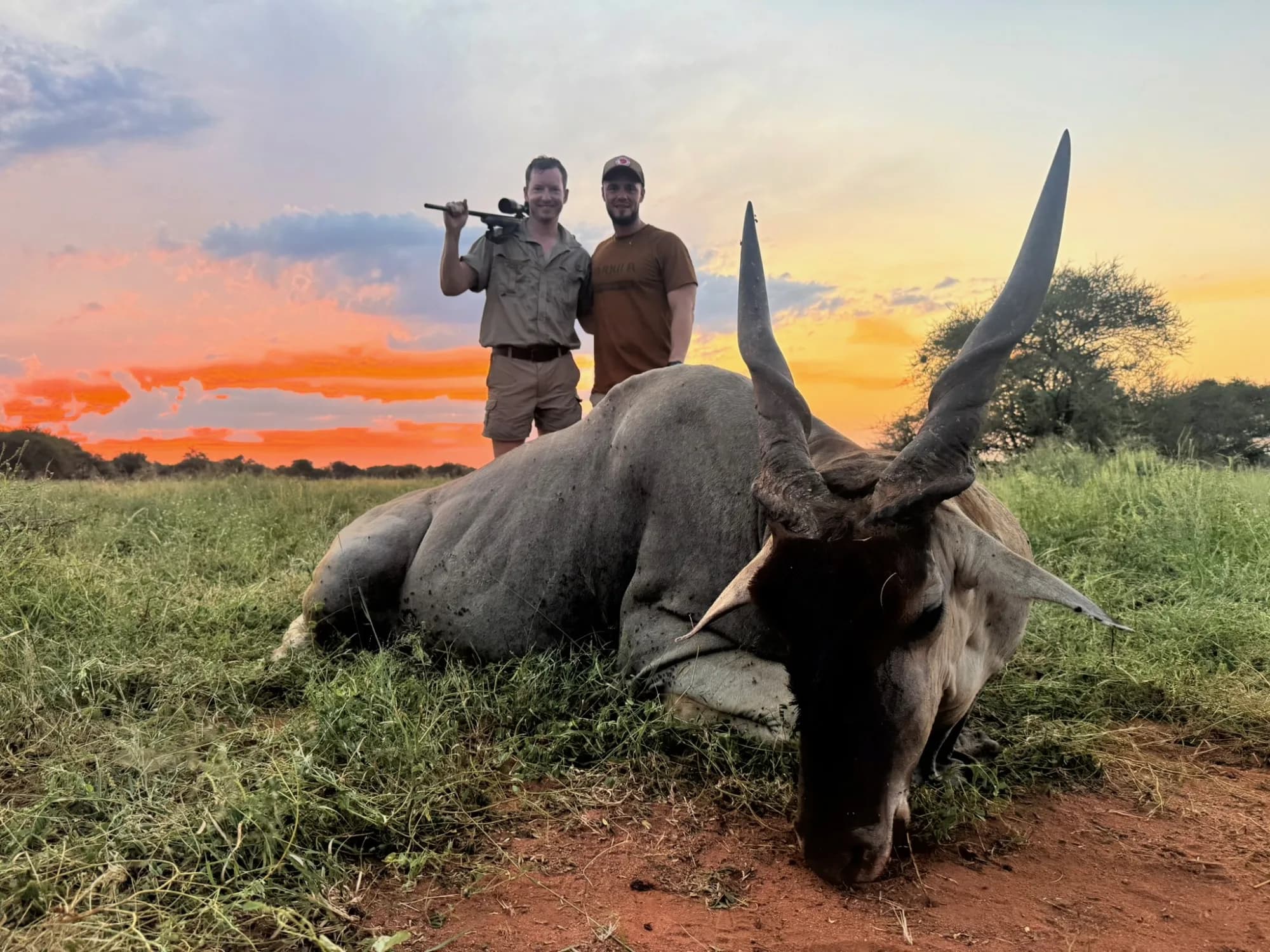

A quality international hunting trip typically costs between €8,000 and €30,000 per hunter, depending on destination, species, and how the trip is organized. A well-hosted plains game safari in South Africa — with proper accommodation, professional hosting, and a meaningful species list — sits toward the upper half of that band. That kind of number shocks some people and strikes others as reasonable. The difference usually comes down to how much they understand about what actually goes into the price.
This is a transparent breakdown of every cost component in an international hunting trip, from the daily rate your outfitter charges to the taxidermy bill that arrives three months after you get home. We run hosted hunting trips across six countries, so these numbers come from real operations — not a brochure.
What makes up the daily rate?
The daily rate — sometimes called a "day fee" or "conservancy fee" — is the foundation of every hunting trip's pricing. In South Africa's Eastern Cape, daily rates for plains game hunts typically range from €250 to €450 per hunter per day. In Spain's Sierra de Andujar, expect €300 to €600 per day depending on the property and season. These rates cover your accommodation, meals, the services of a Professional Hunter (PH), trackers, field vehicles, and basic camp operations.
What most hunters don't realize: daily rates vary dramatically based on ground quality. A €250/day rate in South Africa might put you on overstocked land with high fences and minimal tracking — essentially a walk-up shoot. A €400/day rate on well-managed, low-density concessions in the Eastern Cape means genuine fair-chase hunting with experienced PHs who know every drainage and ridgeline on the property. The daily rate is where the difference between a forgettable trip and a story worth telling often starts.
On a seven-day South African plains game hunt, daily rates alone account for roughly €2,000 to €3,500 of your total cost — typically 15-25% of the final number.
How do trophy fees and conservation levies work?
Trophy fees are species-specific charges paid when an animal is taken. They fund conservation management, anti-poaching operations, and habitat maintenance on the properties where you hunt. In South Africa, trophy fees for common plains game species range widely: Impala from €350 to €500, Blue Wildebeest from €800 to €1,200, Kudu from €1,200 to €2,500, and Gemsbok from €900 to €1,500. A Sable Antelope can run €5,000 to €8,000.
In Argentina, a quality Red Stag trophy fee sits between €2,500 and €4,500 depending on antler class and the estancia you hunt. Greenland Muskox tags are government-regulated at approximately DKK 5,500 (around €750) per animal, but the logistics of getting to the hunting grounds push the total cost well beyond what that tag fee suggests.
Most hunters on a South African plains game trip take four to six animals over seven days. At an average trophy fee of €1,000 per animal, that's €4,000 to €6,000 in trophy fees alone — often the single largest cost component, accounting for 30-40% of the trip total.
Some outfitters offer "trophy included" packages where certain species are bundled into the daily rate. These can represent good value, but read the fine print. The included animals are often younger or smaller representatives, and upgrading to a mature trophy animal may carry a surcharge.
What does travel actually cost?
International flights are the cost component hunters have the most control over — and the one most likely to surprise them if they book late. Return flights from Europe to Johannesburg (O.R. Tambo International Airport) typically run €800 to €1,500 in economy and €3,000 to €5,000 in business class. From the United States, add 20-30% to those numbers. Flights to Buenos Aires from Europe sit around €900 to €1,400 in economy.
Greenland and New Zealand are the outliers. Getting to Kangerlussuaq, Greenland involves connecting through Copenhagen with Air Greenland, and flights can exceed €2,000 return. New Zealand flights from Europe run €1,800 to €3,500 depending on season and routing through hubs like Dubai, Singapore, or Auckland.
Internal transfers add up quickly and are easy to underestimate. A charter flight from Johannesburg to a remote Eastern Cape airstrip can cost €400 to €800 per person each way. Road transfers from Port Elizabeth to hunting concessions run €100 to €250 per person. In Greenland, boat transfers to muskox hunting grounds are a significant line item — €500 to €1,500 per hunter depending on distance and weather contingencies.
Travel typically accounts for 10-20% of a hunting trip's total cost, but on expedition-level destinations like Greenland or New Zealand's South Island tahr country, it can climb to 25%.
What does hosting add — and why does it matter?
A hosting fee is what you pay when a dedicated host manages your entire trip — from planning through execution to trophies arriving home. At Huntica, hosting means a named Huntica host is physically on the ground with you for the duration. Not behind a desk. Not checking in by text. Present, from the moment you land to the moment you leave.
Hosting fees in the industry typically add 20-40% to the outfitter's base costs. On a trip where outfitter costs (daily rates, trophy fees, transfers) total €10,000, a hosting fee might add €2,000 to €4,000.
Here's the honest question: can you book directly with an outfitter and save that 20-40%? Yes. People do it every day. Some have great trips. But here's what that saving actually costs you: vetting the outfitter yourself (with no way to verify claims until you're on the ground), managing logistics across time zones in languages you may not speak, resolving problems alone when they arise, and accepting that nobody is accountable for the overall experience.
We've seen hunters spend six months planning a self-booked trip, fly 10,000 kilometers, and arrive to find the outfitter oversold the week, the PH assigned to them is the lodge's least experienced, and the "prime concession" shown in photos is a two-hour drive from camp. A good host prevents that. A great host turns a good trip into one you'll talk about for years. That's what the fee pays for — someone who owns the outcome, not just the booking. Read more about what our standards look like in practice.
How much do different destinations actually cost?
Total trip costs vary significantly by destination. These ranges represent what a serious hunter should expect to spend per person for a quality, well-organized trip including flights from Europe, daily rates, trophy fees, and hosting — but before taxidermy and shipping.
| Destination | Duration | Primary Species | Approximate Total (per hunter) |
|---|---|---|---|
| South Africa — Magersfontein (Northern Cape) | 7-10 days | Kudu, Sable, Roan, Springbok, Plains Game | €12,000 — €20,000 |
| Spain — Sierra de Andujar | 5-7 days | Iberian Red Deer, Wild Boar, Fallow Deer | €10,000 — €18,000 |
| Argentina — La Pampa / Patagonia | 5-7 days | Red Stag, Blackbuck, Dove | €10,000 — €18,000 |
| Greenland — Muskox Expedition | 7-10 days | Muskox, Arctic Hare | €18,000 — €30,000 |
| Canada — British Columbia / Alberta | 7-14 days | Moose, Elk, Black Bear | €15,000 — €28,000 |
| New Zealand — South Island | 7-10 days | Himalayan Tahr, Chamois, Red Stag | €18,000 — €30,000 |
South Africa's Eastern Cape remains the most accessible entry point for a first international hunting trip — strong variety of plains game species, well-established infrastructure, experienced PHs, and a favorable exchange rate (South African Rand to Euro) that stretches your money further than almost any other destination. Argentina offers similar value with world-class Red Stag hunting and some of the best wing shooting on earth (high-volume dove shooting near Cordoba can be added for €500 to €1,000 per day).
Greenland and New Zealand sit at the expedition end of the spectrum. The species are extraordinary — Muskox on Arctic tundra, Tahr above the treeline in the Southern Alps — but the logistics, remoteness, and short hunting seasons drive costs higher. These are once-in-a-lifetime hunts, priced accordingly.
What hidden costs catch first-timers off guard?
The invoice you settle at the lodge is rarely the final number. Several costs arrive weeks or months after you get home, and first-time international hunters are often caught off guard by them.

Taxidermy and shipping. The most common surprise. A shoulder mount of a Kudu costs €600 to €1,200 at a South African taxidermist — and shipping a crate of trophies to Europe adds €1,500 to €3,000 depending on the number of pieces, the shipping route, and whether you use sea freight or air cargo. Dip-and-pack (treating raw hides and skulls for import) runs €80 to €150 per trophy. Total taxidermy and shipping can easily add €3,000 to €6,000 to a trip — sometimes more than the trophy fees themselves.
CITES permits. Certain species require Convention on International Trade in Endangered Species permits for import. Elephant, leopard, hippo, and crocodile all require CITES documentation. The permits themselves cost €50 to €150, but the paperwork and processing time (8-12 weeks in some EU countries) can delay or complicate trophy imports significantly. Your host or outfitter should handle this — if they don't mention CITES proactively, that's a red flag.
Rifle import permits and hire. Bringing your own rifle into South Africa requires a temporary import permit (SAPS 520 form) applied for at least 60 days before travel. The permit is free but the process is bureaucratic. Many hunters opt to hire rifles on the ground — typically €30 to €80 per day for a quality bolt-action in .308 Winchester or .30-06 Springfield. Ammunition costs run €3 to €8 per round depending on caliber and brand.
Non-hunter companions. Bringing a spouse or friend who won't be hunting? Most lodges charge a non-hunter daily rate of €100 to €250 per person per day, covering accommodation, meals, and activities. On a seven-day trip, that's €700 to €1,750 — worth factoring in early.
Tips and gratuities. Standard practice in Southern Africa is to tip your PH 8-12% of the daily rate and trophy fees combined, with additional tips for trackers (€15 to €25 per day), skinners, and lodge staff. On a €15,000 trip, tips can total €1,000 to €2,000.
Travel insurance. Specialized hunting travel insurance covering rifle loss, trip cancellation, medical evacuation, and trophy loss runs €200 to €500 per trip. Non-negotiable for any serious international hunt.
How should you think about value, not just price?
You can hunt in South Africa for less. Much less. There are operations offering seven-day plains game hunts for €4,000 to €6,000 all-in. Some of those trips are perfectly fine — functional, safe, and you'll come home with trophies on the wall.
But here's what that price point usually means in practice: higher hunter density on the property, less experienced PHs, shorter hunting days because the outfitter is running multiple groups on the same concession, mass-produced lodge food, and nobody whose job it is to make sure the experience — not just the logistics — works.
The difference between a €5,000 trip and a €15,000 trip is rarely about the animals. It's about the ground you hunt on, the people who host you, the hours that were designed around your group specifically, and the moments between the hunting that turn a trip into a story. It's the sundowner spot your host chose because he knows that kopje catches the last light. It's the PH who waits three hours for the right Kudu bull instead of pushing you toward the first legal animal. It's the evening around the fire where friends from three different countries realize they've been laughing together for a week.
That's not a line item on an invoice. But it's the reason people come back. And it's what Huntica Hosted and Huntica Bespoke are built to deliver.
What questions should you ask before booking?
Before you commit to any international hunting trip, ask these questions — of any outfitter, agent, or hosting company:
-
What is and isn't included in the quoted price? Get a written breakdown. Daily rates, trophy fees, transfers, accommodation, meals — and explicitly what's excluded (flights, taxidermy, tips, permits, ammunition).
-
Who will be my PH, and how experienced are they? A named PH with verifiable experience is different from "we'll assign someone when you arrive."
-
What happens if I don't take an animal? Understand whether daily rates apply regardless, whether trophy fees are only on animals taken, and what the policy is on wounded game.
-
How is the ground managed? Ask about stocking practices, fence policies, and conservation management. The answers tell you everything about the quality of the operation.
-
Will someone be accountable for my overall experience? This is the question that separates a booking from a hosted trip. If the answer is "the outfitter handles everything," you're on your own if things go sideways.
-
What are the realistic total costs including post-trip expenses? Any operation that can't give you a realistic all-in estimate — including taxidermy, shipping, and gratuities — either doesn't know or doesn't want you to know.
At Huntica, we answer all of these in the first conversation. Transparent pricing is one of our core standards — because surprises belong in the bush, not on the invoice.
Frequently Asked Questions
How much does a hunting safari in South Africa cost? A quality plains game safari in South Africa's Eastern Cape typically costs €12,000 to €20,000 per hunter for 7-10 days. That includes daily rates (€250-€450/day), trophy fees for 4-6 animals (€4,000-€6,000 total), flights from Europe (€800-€1,500), internal transfers, accommodation, and hosting. Post-trip taxidermy and shipping add €3,000 to €6,000.
What is included in a hunting safari cost? A standard hunting safari price typically covers daily rates (accommodation, meals, PH services, field vehicles), trophy fees for animals taken, and ground transfers. It usually does not include international flights, rifle hire or import permits, ammunition, taxidermy, trophy shipping, dip-and-pack, tips, travel insurance, or non-hunter companion rates. Always request a written inclusion/exclusion list.
Why are hunting safaris so expensive? International hunting trips involve significant operational costs: professional hunters and trackers employed full-time, conservation levies that fund anti-poaching and habitat management, lodge operations in remote areas, field vehicles and fuel, game management across thousands of hectares, and compliance with national and international wildlife regulations. The price reflects the infrastructure required to offer ethical, well-managed hunting on quality ground.
Can I do a hunting safari for under €10,000? Yes. Entry-level plains game safaris in South Africa can start around €5,000 to €8,000 for shorter trips (5 days) with a limited species list and basic accommodation. At that price point, expect higher hunter density, less experienced PHs, and minimal trip design. For a first-time international hunter, we'd recommend investing in a properly hosted trip — the difference in experience is significant.
What is a hosting fee and is it worth paying? A hosting fee (typically 20-40% of outfitter costs) pays for a dedicated host who manages every aspect of your trip — vetting the ground, designing the itinerary by the hour, being physically present throughout, resolving issues in real time, and ensuring the overall experience matches what was promised. It's the difference between booking a hunt and being hosted on one.
How much does taxidermy and shipping trophies home cost? Taxidermy costs vary by mount type and species. In South Africa, a shoulder mount runs €600 to €1,200 per animal. Dip-and-pack (preparing raw trophies for export) costs €80 to €150 per trophy. Shipping a crate of 4-6 trophies to Europe via sea freight costs €1,500 to €3,000. Total post-trip trophy costs of €3,000 to €6,000 are common for a standard plains game safari.
Tell us where you want to go
Every hunter's first question is about cost. The better question is about value — what kind of trip do you want to look back on? We're happy to walk you through realistic numbers for any destination and help you understand exactly what you'd be paying for, with no pressure and no surprises.