
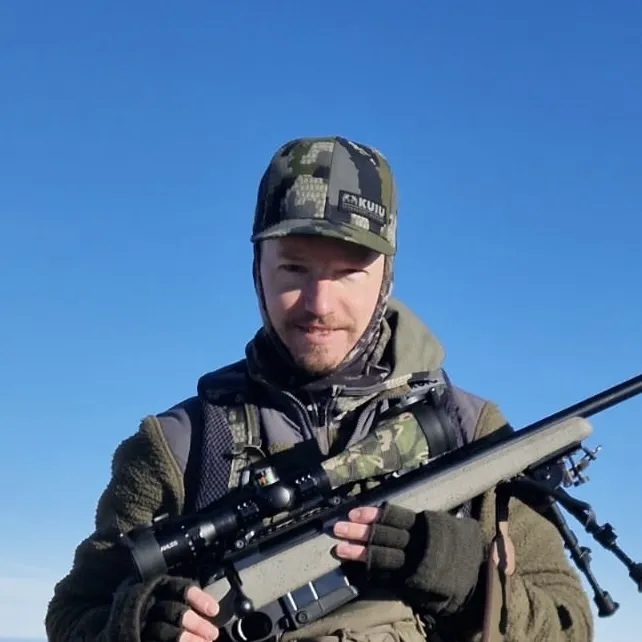
Two countries produce the finest red stag hunting outside continental Europe, and they don't feel anything alike in the field. New Zealand puts you into beech forest and above the bushline into the Southern Alps, glassing basins where a stag's roar rolls off rock faces. Argentina puts you on open pampas and caldén woodland in La Pampa, where you can hear a rutting stag from half a kilometre away across flat, treeless country. Both are red stag — Cervus elaphus — both can produce genuinely world-class antlers, and both get asked about in nearly the same breath by hunters planning a roar season trip.
I host New Zealand personally — it's one of my home grounds at Huntica. I've walked those alpine basins in the cold before first light more times than I can count. Argentina is hunted and hosted by our team every season, and the two destinations get compared constantly by hunters trying to choose. Here's the direct version: what's actually different, and which one fits the trip you're planning.
For the full single-destination deep dive, read our complete Argentina red stag guide — it covers calibers, shot placement, firearms paperwork, and the full roar experience end to end. This piece is the head-to-head.
The short answer
Both countries put you in front of red stag during a genuine roar, both can produce trophies that would be remarkable anywhere in the world, and both are workable trips from the US, Europe, or the Gulf. The differences that actually decide which one you should book come down to four things: when the roar peaks, what kind of ground you're walking, how honestly "free-range" describes the stag you take home, and how far you have to fly.
New Zealand's roar is tighter and slightly later — peaking in the final ten days of March into the third week of April — and a meaningful share of New Zealand's biggest-scoring stags come off managed, fenced game estates rather than open wilderness. Argentina's roar starts and peaks roughly two weeks earlier, runs on genuinely open estancia ground in La Pampa and San Luis, and its broader season stretches further into the year for hunters who'd rather stalk than call. Not every outfitter volunteers these details upfront. We will, section by section.
Roar timing: how the two seasons actually line up
New Zealand's red stag roar peaks from around March 20 to April 20 — the tightest, most reliable window on the calendar, and the one that books out earliest with New Zealand outfitters. Outside that window, the wider season runs February through September, but February and the post-roar months of May through July are quieter hunting: stags are less vocal and more solitary.
Argentina's roar runs earlier and looser. Stags begin separating from bachelor groups in early March, roaring builds through the second and third week of March, and the roar itself peaks in the first three weeks of April — with the best calling and the most reckless stag behaviour concentrated from mid-March through early April. Argentina's red stag season as a whole extends from around March through September, because La Pampa and Patagonia estancias keep hunting post-roar stags in a stalking format long after the vocal window has closed.
Practically: if the roar itself — the calling, the wallows, a stag walking stiff-legged toward a caller — is the whole point of the trip, book the last week of March through mid-April in either country and you'll get it. If you want flexibility to shift a trip by a few weeks and still find a rewarding hunt, Argentina's longer season gives you more room to move without losing the experience entirely.
Terrain and hunting style: alpine basins vs. open pampas
This is where the two countries diverge the most, and it should be the deciding factor for a lot of hunters before cost ever enters the conversation.
New Zealand red stag hunting happens in beech-forest river flats and native bush that climb into alpine tussock and scree above the bushline. Terrain is broken, often steep, and physically demanding — even a moderate red stag hunt on the South Island involves real elevation change and uneven footing. The upside is some of the most dramatic scenery in world hunting: Southern Alps peaks, glacial rivers, and, on multi-species trips, a direct step up into genuinely mountain terrain for Himalayan tahr and Alpine chamois on the same itinerary.
Argentina red stag hunting happens on open grassland and caldén woodland — a native Prosopis forest that provides cover without serious elevation. La Pampa and Buenos Aires province estancias are walkable, low-relief ground where spot-and-stalk means covering distance across open country and using tree lines for cover, not climbing. Patagonia's Andean foothills in Neuquén and Río Negro offer a more mountainous, physically demanding version of Argentine stag hunting for those who want it, but the flagship experience — and the one most first-time Argentina hunters book — is the flat-to-rolling La Pampa estancia hunt.
If you want a genuinely physical mountain hunt with red stag as the entry point to bigger alpine game, New Zealand is built for that. If you want a lower-impact hunt where the terrain doesn't fight you and the roar itself carries the drama, Argentina's pampas country is the easier walk.
Trophy character and scoring: what "free-range" actually means here
This is the section where we'd rather be honest than tell you a nicer story, and it's the single biggest thing hunters get wrong when comparing these two countries.
New Zealand scores red stag two ways: the Douglas Score, New Zealand's own system devised by Norman Douglas in 1949 and still used by the New Zealand Deerstalkers' Association, and the international SCI system used for cross-border comparison. Douglas Score rewards symmetry heavily — there's no non-typical category — and a widely cited New Zealand benchmark trophy is a 12-point stag around 40 inches of main beam, roughly 300 Douglas Score. Here's the part worth saying plainly: the large majority of New Zealand's highest-scoring stags — the 350-inch-plus SCI animals most outfitter price lists lead with — come off managed, fenced game estates, not open wilderness. Genuinely free-range New Zealand red stag exists and is hunted every season, but it typically produces smaller, harder-earned stags in the 250-300 SCI range with a lower, more honest success rate than the estate figures.
Argentina scores almost exclusively in SCI, with CIC used by some European hunters. Free-range red stag on La Pampa and San Luis estancias typically scores 280-350 SCI — genuinely wild, self-sustaining populations on open, largely unfenced land. High-fence estate operations exist in Argentina too, and they push scores considerably higher: 400 SCI and up, with gold-medal estates reaching 500-600 SCI for a meaningfully higher trophy fee. The difference from New Zealand is which ground is the more common default booking. In New Zealand, the bigger-scoring price tiers more often assume estate ground. In Argentina, a standard free-range package on La Pampa or San Luis is the more common starting point, and it lands in roughly the same working trophy range as New Zealand's genuine free-range hunting.
Neither country is dishonest by default. Both have real free-range hunting and both have real fenced estates producing bigger antlers for a higher trophy fee. Ask your outfitter directly which kind of ground you're booking, on either continent, every time.
Travel and logistics: getting there from the US, Europe, and the Gulf
Flight time is not a minor detail on a trip this long, and it splits sharply depending on where you're starting from.
From Europe, Argentina wins decisively. Direct flights connect London to Buenos Aires nonstop in roughly 14 hours, with total door-to-door travel typically 14-19 hours depending on connections at either end. New Zealand has no direct European service — Christchurch or Auckland from London runs 23-28 hours including at least one connection, close to ten hours longer door to door. For a European hunter weighing the two purely on travel fatigue, Argentina is the easier trip by a wide margin.
From the US, it's closer than most people assume, but not identical. Los Angeles to Auckland is a genuine nonstop of roughly 13-13.5 hours. Los Angeles to Buenos Aires currently has no nonstop option — every routing goes through a connection — so even though the raw flying time is similar, door-to-door tends to run longer than New Zealand's single long-haul leg. Both get considerably longer again from the East Coast. If a one-flight West Coast departure matters to you, New Zealand has the edge here; if it doesn't, pick based on the hunt.
From the Gulf, both destinations are genuine long-haul trips with no real shortcut. Dubai to Christchurch runs roughly 17-19 hours depending on routing; Dubai to Buenos Aires runs roughly 18.5-20 hours. New Zealand is marginally shorter, but the gap is small enough that it shouldn't drive the decision for a GCC-based hunter — both require a full day of travel each way.
On a Huntica Hosted trip, we handle every leg of this — international routing, domestic connections, and, in New Zealand, helicopter transfers into remote hunting country — so the travel time is the one number you don't have to manage yourself.
What each hunt costs
Neither country is inexpensive, and neither should be sold to you as such. Here's the honest range, all-in and excluding international flights, for a hosted hunt taking a representative, working-range stag rather than a record-book outlier.
| New Zealand | Argentina (free-range) | |
|---|---|---|
| Roar peak | Mar 20 – Apr 20 | Mid-March – mid-April, peaking late March |
| Broader season | Feb – Sep | Mar – Sep (some estates to Aug) |
| Typical hunt length | 4–7 days | 5–7 days (7–9 in Patagonia) |
| Daily rate | $300–$550/day (peak roar guiding) | $250–$350/day (most sold as set packages) |
| Trophy fee, representative stag | $3,000–$7,500 for a bronze-to-silver stag up to ~375" | Often bundled into the package; ~$3,000–$4,500 if priced separately |
| Typical all-in, excl. flights | $8,500–$12,000 for a stag up to ~360 SCI | $7,000–$10,500 for a free-range stag, 280–350 SCI |
| Higher trophy-tier pricing | Gold (400–425") ~$9,500; 475–500"+ can exceed $17,000 | Estate 400 SCI ~$8,000–$10,000; gold-medal 500–600 SCI can run $19,000–$50,000+ |
| Success rate | 95–100% on estate ground | 95–100% on La Pampa/San Luis free-range ground |
Both figures exclude international flights, taxidermy, and trophy shipping. Argentina's baseline tends to sit slightly below New Zealand's for a comparable working-range trophy, in part because New Zealand's peak-roar guiding rates run higher and helicopter access into remote country adds cost that Argentina's flatter, road-accessible ground doesn't require. On a Huntica Hosted or Huntica Bespoke trip, we quote against the specific ground and trophy expectation rather than a generic figure — see our full breakdown of hunting safari costs for how these two destinations compare against Africa and Europe.
Firearms logistics differ too. New Zealand requires a Visitor Firearms Licence (NZ$25) plus a police import permit, and the standard advice is to apply at least four months ahead. Argentina's process runs through RENAR — Argentina's national firearms registry, renamed back from ANMaC in 2025 — with a temporary import permit costing roughly $80 and valid for 90 days, arranged through an Argentine consulate before travel. Many hunters in both countries sidestep the paperwork entirely and use an outfitter's rifle, which is a normal, sound option on either continent. See our international firearm import guide for the full process either way.
Choose New Zealand if…
- You want red stag as the entry point to a genuine mountain trip — tahr and chamois on the same itinerary, in real alpine terrain.
- You want the tightest, most reliable roar window and don't mind booking well ahead to get it.
- You and your group can handle steep, physically demanding terrain and want that as part of the experience, not despite it.
- You want the option of helicopter-access backcountry hunting alongside a lodge-based stag hunt.
- Non-hunting companions in your group want world-class hiking, trout fishing, and wine country nearby.
Choose Argentina if…
- You want a lower-impact, spot-and-stalk hunt where the roar itself — not the terrain — carries the intensity.
- You're travelling from Europe and want to cut roughly ten hours off your total flight time.
- You want to add high-volume dove shooting in Córdoba to the same trip — a combination New Zealand simply can't offer.
- You want a working free-range trophy in the 280–350 SCI range as your default booking, not an upsell.
- Estancia hospitality — long asado dinners, Argentine wine, a slower evening rhythm — matters to you as much as the hunting day.
What the hosted experience actually feels like, day to day
The difference isn't just terrain and cost — it's the rhythm of the trip.
In New Zealand, mornings start early and cold, glassing river flats and basins from a ridge before the wind comes up. The lodge is often a private wilderness property overlooking a mountain valley, and evenings are quiet — the kind of tired that comes from real elevation gain. On a multi-species trip, day five or six might mean a helicopter lift into tahr country, shifting the whole character of the hunt from bush-stalking to mountaineering.
In Argentina, mornings start in near-darkness on flat ground, listening before you glass — the first roar cutting across cold pampas air, then three or four more answering from different directions. The estancia is a working ranch house with thick adobe walls and an open fire, and evenings are the opposite of quiet: a long asado, Argentine wine, and conversation that runs late. By day three, a group of strangers usually feels like it's known each other for years.
Both are genuinely Huntica Hosted trips — a founder or team member on the ground for the whole hunt, managing the days when the wind won't cooperate or the roar goes quiet for 48 hours. That part doesn't change between the two countries. Almost everything else does.
Frequently Asked Questions
Which country has bigger red stag trophies?
On a like-for-like free-range comparison, the two are close: both La Pampa/San Luis Argentina and genuinely free-range New Zealand ground typically produce stags in the 250–350 SCI range. New Zealand's largest-scoring trophies, 350-inch-plus SCI, are more commonly taken on managed, fenced game estates rather than open wilderness — a distinction worth asking your outfitter about directly on either continent, since fenced estates in both countries can also produce exceptional gold-medal-class stags for a correspondingly higher trophy fee.
Can I hunt both countries in the same year?
Yes, and the seasons make it realistic in theory. Argentina's roar peaks about two weeks earlier than New Zealand's, so a hunter with the time and appetite could hunt Argentina's peak roar in late March and still make New Zealand's window in early-to-mid April, though it would mean a demanding travel schedule across two long-haul legs in a short window. Most hunters treat these as separate-year trips rather than one combined itinerary.
Is New Zealand red stag really free-range?
Some of it is. New Zealand has genuine free-range red stag hunting on public and private wilderness ground, but the large majority of the country's highest-scoring, near-certain-opportunity hunts — including most of the 95–100% success rate offers built around gold and super-gold trophy tiers — happen on managed, fenced estate ground. Free-range New Zealand stag exists, is hunted every season, and typically produces smaller trophies in the 250–300 SCI range with a lower, more honest success rate. Ask directly which kind of ground you're booking.
Do I need to bring my own rifle to either country?
No. Both countries have straightforward paths that don't require importing a personal firearm. In New Zealand, a Visitor Firearms Licence (NZ$25) plus a police import permit is required if you bring your own rifle, applied for at least four months ahead; many outfitters rent quality rifles instead. In Argentina, RENAR issues a temporary import permit for about $80, valid 90 days, or you can rent an estancia rifle and skip the paperwork entirely. On a Huntica trip, we handle whichever path you choose.
Which trip costs less overall?
Argentina runs slightly lower for a comparable working-range trophy — roughly $7,000–$10,500 all-in versus New Zealand's $8,500–$12,000, both excluding flights. Factor in travel and the gap can shift: Argentina is dramatically faster to reach from Europe and costs less to fly to, New Zealand currently has the edge from the US West Coast (a genuine nonstop vs. a connection to Buenos Aires), and New Zealand is marginally faster from the Gulf. Trophy-tier estate hunts in both countries scale well beyond these baseline ranges — see our hunting safari costs breakdown for the full picture.
Can I add other species to a red stag trip in either country?
Yes, and this is one of the clearest differences between the two. New Zealand's classic addition is Himalayan tahr and Alpine chamois — both genuine high-mountain species requiring real alpine terrain, often reached by helicopter on a multi-species itinerary. Argentina's classic addition is high-volume dove shooting in Córdoba province, a completely different discipline: wing shooting hundreds of birds a day rather than stalking a second big-game species. Neither combination is better; they're built for different hunters. See our New Zealand red stag page and Argentina red stag page for the specific combination options on each ground.
Tell us where you want to go
Both of these countries can give you a roar season you'll talk about for years — they just do it in completely different ways. If you're trying to decide between them, that's exactly the conversation to have with us directly. Tell us where you want to go, and we'll walk through the ground, the season, and which of these two hunts actually fits the trip you're picturing. No brochures, no push toward the bigger number — just a straight conversation between hunters.