
There are moments in hunting that leave a mark far deeper than the trophy on the wall. Moments where adrenaline, emotion and self-doubt collide in a way that humbles you to the core.
This is one of those.
To date it is my most humbling experience as a hunter — and maybe one you can relate to if you have ever stood in front of something bigger than yourself, both literally and figuratively. There was a point during this hunt where things could have gone badly wrong. And yet it turned into a memory I will never forget, not because everything went perfectly, but because it almost did not.
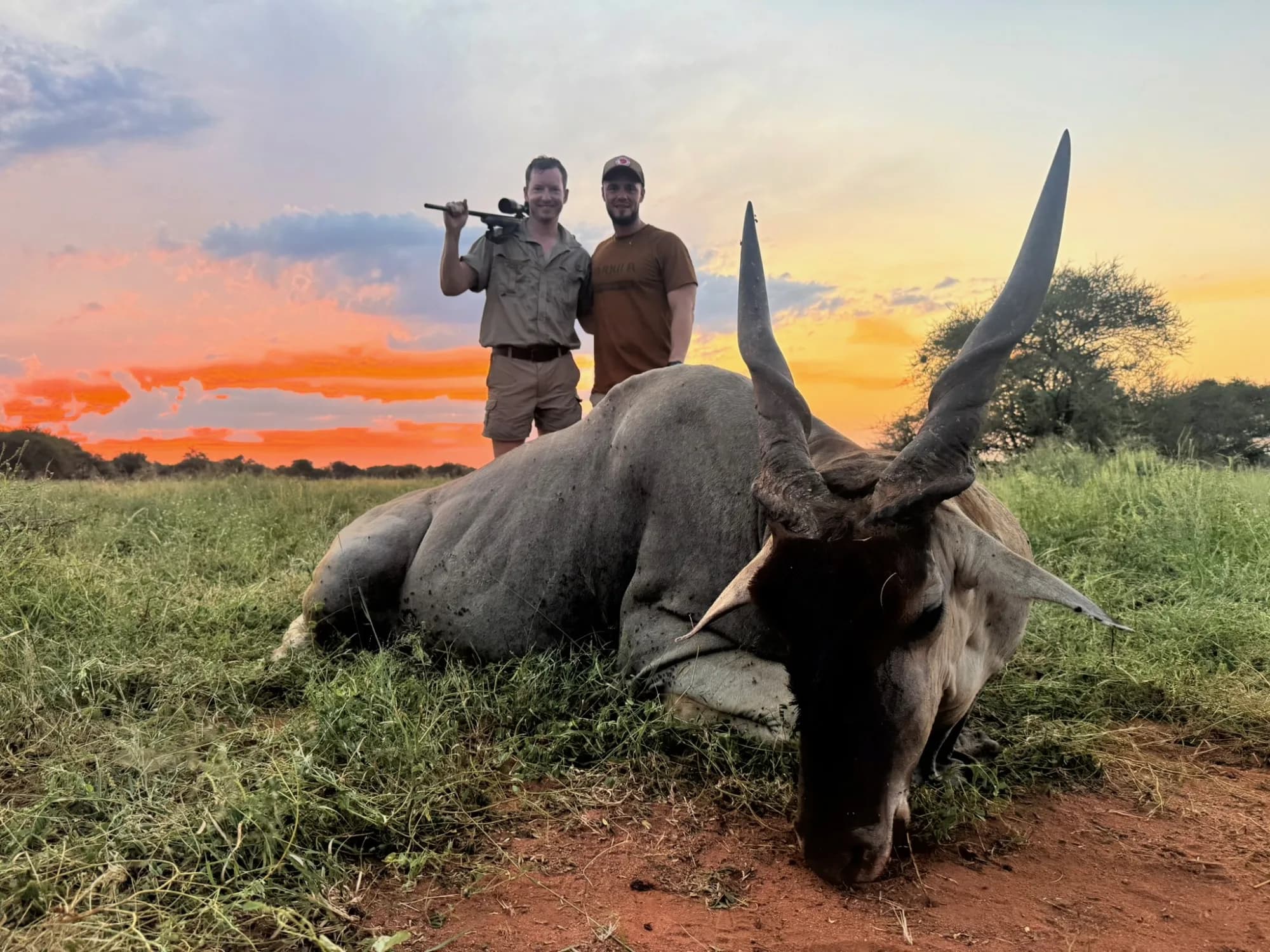
On the second-to-last day of my first South African hunt I came across an enormous Livingstone eland bull. Here is the honest version.
The plan we made, and the plan that changed
Going into my first trip to South Africa I felt in good hands. I travelled with three experienced friends and with Alex — a born-and-raised South African, a licensed professional hunter, and today my business partner and Huntica's lead host. He and the others had already told me the stories and prepared me as best they could, knowing full well I would not really understand any of it until I stood with my own boots on the red soil, glassing over plains holding species that we Northern Europeans normally only see behind a fence in a zoo.
Alex had advised me on which species suit a first-timer, based on the style of hunting as much as the cost. I did not have the means to go straight at kudu, nyala, crocodile, hippo, buffalo, giraffe and everything else on the list. I also knew what I did not want: days sitting in a blind, or spending precious hours of rest out night-hunting, which we do plenty of in Sweden for wild boar and which is not my favourite way to hunt. We settled on impala, blesbok, springbok, duiker, jackal and warthog — knowing the list could change once we arrived, because anything can happen in the bush.
By the back end of the week we had acclimatised to the summer heat and fallen into the rhythm of eat, sleep, hunt, repeat. I had set my eyes on gemsbok. It is an animal so well adapted to its habitat, especially in how it holds water, and it stands out beautifully with that mask and those long, narrow horns. I felt confident: a blesbok taken with a clean lung shot at 280 metres, a spooked impala ram out of thick bush at 120, a guinea fowl and a francolin with a .22. A gemsbok would have been the perfect finale — a trophy above the dinner table and a reminder of an epic savannah adventure.
The others had finished their lists, so the whole crew was focused on finding me one. We simply did not have the luck that day. Every chance that had come easily earlier in the week seemed to evaporate into the hot air of the bushveld, and I started to accept that this might be it — grateful for what I already had, and for the week we had shared.
Why the eland got under my skin
Leading up to the trip, eland was not seriously on my radar. I knew the species and its presence, but I also knew they can be difficult and time-consuming to hunt, and the trophy fee sat outside what I had set aside. After a week of seeing solitary bulls in the distance, and the mounts hanging at the lodge, it had grown on me.
The eland is the largest of the spiral-horned antelopes. Mature bulls run upward of a thousand kilograms. There is something mythical about them — the stature, the natural history, what they meant to the people who lived alongside them long before any of us arrived with rifles. And do not let the size fool you. This animal can clear a two-metre fence from a standstill and then vanish like a ghost in thin bush.
Our friend Chris had been talking all week about taking an eland bull, but he was locked in a waiting game with an old crocodile at a lake nearby. We had only seen singles, small groups, and no bulls. We had been ribbing each other that I would take the bull if the chance came, purely to wind him up. I did not believe for a second it was realistic.
Be careful what you wish for.
What a Livingstone eland actually is
Worth clearing up, because it confuses a lot of first-time hunters and most price lists are vague about it.
"Eland" on a South African species list almost always means the common eland, and the two forms you will hear named are Cape eland and Livingstone eland. Livingstone bulls typically show the faint vertical body striping more clearly, carry a darker, denser mat of hair on the forehead, and tend to be the longer-horned of the two. Cape eland are generally the heavier-bodied, plainer animal of the southern mountains and the Eastern Cape.
In practice the distinction is less clean on the ground than it looks in a record book, because both have been widely moved and mixed across South African ranching country for decades. The honest answer is to ask the outfitter which form his ground actually holds, and to judge the individual bull in front of you rather than the label on the price list. Ours was unmistakably Livingstone-typed: faint stripes, a heavy dark brush, and the blue-grey cast that old bulls take on as the hair thins over the hide.
That grey-blue tinge is one of the best ageing cues you have. So is the forehead brush, which thickens and darkens with the years, and the dewlap, which deepens. And if you are close enough on a still evening, listen — a mature bull's tendons make a distinct clicking sound as he walks. On a heavy old animal you can hear him before you can properly see him.
The stalk
Late afternoon. We left the others at the Land Cruiser and Alex, our PH Martin and I moved toward one of the big open plains where we had seen gemsbok earlier. It was the last chance of the day and, deep down, I had already half given up.
Instead of gemsbok we found eland. Cows at first — and then a giant, muscular, dark-faced bull stepped clear of them. Hearts going immediately.
The sun was dropping fast. Standing in the middle of the herd at 400 metres there was no safe shot, and even Martin was struggling to keep a lid on it. He asked in a whisper whether I wanted to go for it. I said yes before he had finished the sentence, forgetting entirely about what I had set aside for the week and about the gemsbok that might still have been standing behind a thorn tree somewhere.
We had to close the distance. Martin in front, me in the middle with the .300 Win Mag, Alex behind, and a scattering of zebra and wildebeest between us and the herd that would blow the whole thing if they caught us moving. Twenty minutes of stalking around them, drenched in sweat, before we found a workable position at 200 metres.
And we were almost too late.
The shot I should never have taken
The herd had already started drifting toward the thick bush, where they would be gone for good. I could see the window closing. The bull began to cross into cover, trees and scrub breaking him up.
I panicked.
It was not only the trophy slipping away. It was a long week, not enough sleep, the slow build of the whole day, and all of it arriving at once. My only thought was that this bull had to go down. Full-blown buck fever. I squeezed the trigger on a glimpse of him through the brush.
No impact.
Alex and Martin turned on me instantly, and rightly: "No, no, no — what are you doing?"
I have rarely been so embarrassed. I had just taken a stupid, irresponsible risk of wounding a magnificent animal and ruining any chance that was left, and it goes against everything I believe about how to hunt. But there I was. An absolute rookie.
I want to be plain about this rather than leave it out, because it is the part that matters. The unforgivable mistake in that moment was not missing. It was shooting into brush at an animal I could not see cleanly, on a herd animal, with light going. Every one of those was a reason to let him walk. A bull you let go is a story you tell in the truck. A bull you wound in the last light is one you carry.
The second chance
Then something I did not expect. The herd had clearly heard the shot but did not spook — perhaps because they read the noise as coming from the direction they were already heading. They turned around, back out onto the plain.
Alex and Martin picked me up immediately and got me refocused. I had seconds to climb out of the hole I was spiralling into.
A couple of long minutes later the bull stood clear of the herd and the brush, broadside, at 200 metres, in front of a Bergara B14 in .300 Win Mag and a Swarovski Z8 wound to twelve. Who gets to be this lucky, I thought.
I squeezed. The impact on that heavy shoulder was unmistakable. He moved off and we heard his breathing settle in the tall grass, stationary, and knew it was nearly over.
I was shivering in spite of the heat. The fever was finally draining out of me and a thousand things were running through my head — who was I to take this animal after that, had I earned the right, and everything else across the spectrum of excitement and sadness at once. Martin had already called the others on the radio, and they were racing over convinced I had finally got my gemsbok. Short-term despair to celebration with my friends inside ten minutes. There is no better description than a world-record rollercoaster. That is what hunting can do.
When he lay still and I saw the peace in his eyes, my shoulders came down. In the couple of minutes before the others arrived, I made my peace with him. He had been taken cleanly in the end, and no other animal had been hurt on the way there. It could have gone very differently, and I still think about it — but I try to live with it by using it, and by remembering that something bad can turn around in the space of a heartbeat.
By his size and condition he had lived a long life and spread plenty of himself around the herd. His going made room for new blood, and his meat fed us and the local community. The sense of unworthiness got replaced fast by gratitude — to the bull, and to Diana or whoever it was that turned that herd around and gave me one more chance. I do not consider myself a religious man, but hunting and being in wild country definitely wakes something spiritual in me.
Chris got his crocodile in the end, by the way. So I did not feel too sorry about taking "his" bull.
What I do differently now
I have hosted a lot of hunters since, and I watch for this in other people because I know exactly what it looks like from the inside.
Decide your no before you need it. Standing in the moment is the worst possible time to work out whether a shot is acceptable. Say it out loud at the truck on day one: no shots into brush, no shots at an animal I cannot see the shoulder of, no shots into a bunched herd, nothing after legal light. A rule you set when you are calm is the only rule that holds when you are not.
Give your PH the veto and mean it. Alex and Martin were right and I was wrong, and the half-second in which I could have listened was gone before I used it. Now I tell the hunters I host to treat "not yet" as final, not as an opening position. If you are paying for local knowledge, that is the moment you are actually paying for.
Name the fever out loud. The tell is that everything narrows to one thought — it has to happen now. Saying "I'm shaking" to the man next to you breaks the loop better than anything else I have found. It is not weakness. Every honest hunter has been there.
Treat tiredness as a shooting condition. Six days of heat, early starts and short nights degrade judgement in exactly the same way wind and light do, and nobody puts it on the list. If it is day six and you have been up since four, assume your decision-making is worse than you think it is.
Let it cost you something. The reason this is worth writing down rather than quietly forgetting is that I nearly wounded a magnificent animal and got away with it on luck. Luck is not a method. What you owe the animal is the discipline to be the kind of hunter who does not need it — which is the whole of what we mean by Approved Ground and the standard we hunt to.
What it takes to hunt eland well
If eland is going on your list, the practical picture looks like this.
Bring enough rifle. An eland bull is the size of a bull in a field, built heavy through the shoulder, and famously stoic about being hit. A .300 Winchester Magnum is a sensible floor — it is what I used — and a .338 or a .375 H&H is what a lot of experienced Africa hands will tell you to bring instead. Bullet construction matters more than the number on the barrel: use a heavy-for-caliber bonded or monolithic bullet that will hold together through heavy shoulder bone. This is not the animal for a fast, frangible bullet.
Shoot the shoulder, not behind it. On a broadside bull, take him on the shoulder rather than the soft spot behind it. You want bone and the top of the heart-lung triangle. Eland absorb a lot and can travel a long way with a marginal hit, and following one into thick bush at last light is exactly the situation nobody wants.
Expect a stalk, not a sit. They are herd animals in open and semi-open country, so the challenge is almost never finding eland — it is closing on a mature bull with cows, calves and every other pair of eyes on the plain working against you. Expect long approaches on foot and a lot of aborted attempts. Outfitters on managed Northern Cape ground quote success rates above 90% over five to seven days; that number reflects how findable eland are, not how easy a mature bull is.
Hunt the dry winter. May through September is the window — grass is down, animals concentrate around water and feed, and visibility for both glassing and stalking is at its best. June to August is prime. We hunted late season in the heat, which is workable but harder.
Plan on five to seven days for eland alone, or seven to ten if you are combining it with the plains-game species most people pair it with. Our own ground, seasons and species pairings for this hunt are set out on the eland hunting page, with the wider species picture on the eland hub and South Africa destination page.
Plan the mount before you shoot it. A full shoulder mount on an animal this size is a serious object and a serious shipping bill, and it is much better decided in advance than in the skinning shed. Our trophy shipping and taxidermy guide covers what actually happens between the field and your wall.
Frequently Asked Questions
What is the difference between a Livingstone eland and a Cape eland?
Both are forms of the common eland. Livingstone eland typically show the faint vertical body stripes more clearly, carry a darker and denser brush of hair on the forehead, and tend to be longer-horned. Cape eland are generally heavier-bodied and plainer, associated with the southern and Eastern Cape mountains. Decades of game ranching have mixed and moved both across South Africa, so the distinction is less clean on the ground than in a record book — ask the outfitter which form his ground holds, and judge the individual bull rather than the label.
What caliber should I use for eland?
A .300 Winchester Magnum is a reasonable minimum, and many experienced Africa hunters prefer a .338 Winchester Magnum or a .375 H&H for an animal of this size. Bullet construction matters as much as caliber: a heavy-for-caliber bonded or monolithic bullet that penetrates heavy shoulder bone is essential. If your trip pairs eland with kudu, gemsbok and other plains game, a .300 Win Mag or .375 H&H covers the whole list without a rifle change.
Where do you aim on an eland?
On a broadside bull, take the shoulder rather than the softer spot behind it — you want the shoulder bone and the upper heart-lung area. Eland are famously stoic and can cover a lot of ground on a marginal hit, and tracking a wounded bull into thick cover in fading light is the situation to design your whole approach around avoiding. If the shoulder is not clearly visible, that is not a shot.
How big is a mature eland bull?
Mature common eland bulls run upward of a thousand kilograms, making them the largest of the spiral-horned antelopes. Despite that mass they are remarkably athletic — an eland can clear a two-metre fence from a standing start. Old bulls develop a deep dewlap, a thick dark forehead brush, and a blue-grey cast to the hide as the hair thins, which together are the most reliable field cues for age.
When is the best time to hunt eland in South Africa?
May through September, the Southern Hemisphere dry winter. The grass is down, game concentrates around water and feed, and both glassing and stalking conditions are at their best, with June to August generally prime. Hunting is possible outside that window — my own hunt was late-season in real heat — but conditions make it materially harder.
What does an eland hunt cost in South Africa?
Daily rates on South African plains-game ground typically run around $350–$450, with some Northern Cape operators at $400–$600. Eland trophy fees for a representative bull generally sit around $1,600–$2,200 at mid-tier outfitters, with premium, heavier-horned bulls running $2,500–$4,250. Most hunters fold eland into a broader plains-game itinerary rather than booking it alone. On a hosted Huntica trip the whole thing is quoted as one written all-in figure against your actual species list rather than a fixed price up front — the safari cost breakdown explains how the components fit together.
How do you deal with buck fever?
Set your shot rules out loud before the hunt starts, when you are calm — no shots into brush, none at an animal whose shoulder you cannot see, none into a bunched herd, none after legal light. Give your PH an absolute veto and treat "not yet" as final. Say it out loud when you feel yourself shaking, because naming it breaks the tunnel vision faster than anything else. And treat accumulated tiredness as a shooting condition in its own right, exactly like wind or light.
Tell us where you want to go
I have hunted a lot since that evening, and this is still the animal I think about most — partly because of what he was, and partly because of how close I came to not deserving him. If you have never hunted Africa, the first African safari guide is the honest primer, and gemsbok, impala and springbok are the species that most often fill out a first list alongside a bull like this one.
If eland is on your mind, tell us where you want to go and I will walk you through the ground that suits it, the season that makes sense, and what a hosted trip built around your list actually looks like. No brochures, no price sheets. Just a straight conversation between hunters — including, if it is useful, the parts that did not go to plan.